
What does terracing mean?
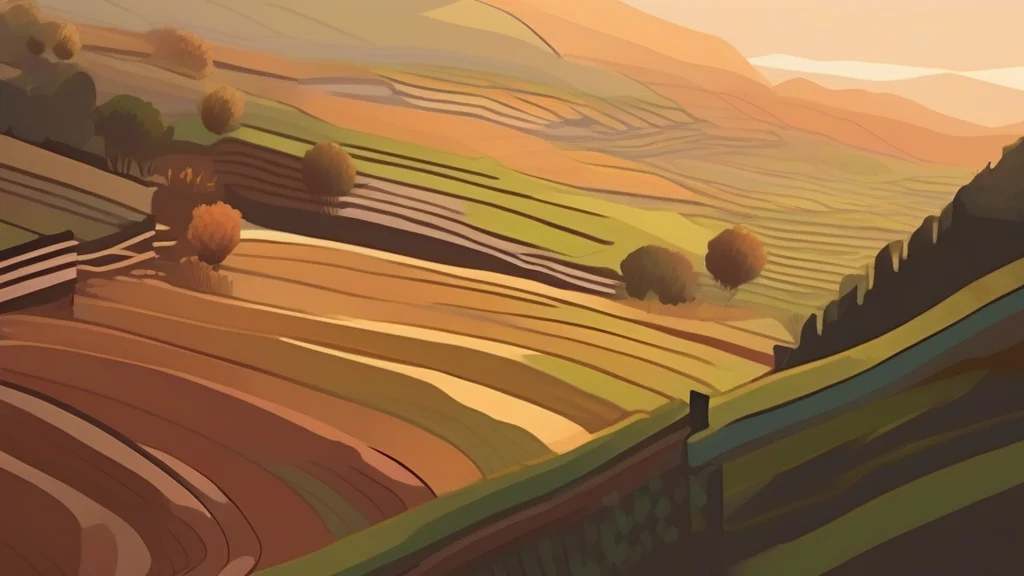
Terracing is the practice of reshaping sloping ground into a sequence of level or gently graded steps, each supported by a wall or bank. The resulting steps may be used for farming, gardening, roads, buildings, or landscape design. Terracing can help make steep terrain usable while slowing runoff and reducing soil erosion. The word is especially common in discussions of agriculture, civil engineering, and landscaping, where it can refer both to the process and to the completed arrangement of terraces. It has a largely practical and technical character, though it also carries aesthetic associations when used to describe formal gardens or dramatic mountain landscapes. Although the word may sound modern because of contemporary landscaping projects, terraced farming is ancient. Terracing appears in entries about the noun collective form, particularly for areas of stepped land, and as a gerund or present participle describing the work of forming such steps.
A series of level or gently graded steps formed on sloping land, or the land arranged in this way.
"The terracing below the village provided flat ground for several small farms."
Often treated as a collective or mass noun; a plural form is uncommon.
To shape sloping land into level or gently graded steps, or to provide an area with such steps.
"Engineers terraced the unstable slope before constructing the path."
Used as a gerund or present participle; most common in agriculture, engineering, and landscaping.
Rare; terracing is usually used as a mass or collective noun, with plural forms only when referring to multiple separate arrangements or acts.
"Several ancient terracings survive in the valley."
Before terracing became a landscaping trend, it was a survival tool: ancient farmers used steps to make steep land productive and limit soil erosion.
Reviewed by Deb Chak, Editor. AI-assisted content curated by RJS Tech Solutions LLP.
Where does terracing come from?
English borrowed the noun terrace from French terrasse in the late 16th century. The French word is related to Italian terrazza and ultimately to Latin terra, meaning “earth.” The modern form terracing was created by adding the suffix -ing, originally to the verb terrace and later used as a gerund and present participle.
Related word forms
How terracing is actually used
The noun is most common in agriculture, landscaping, construction, and geography. As a verb, terracing is a specialist term associated chiefly with shaping land or constructing stepped platforms.
Easily confused with terracing
Tarring means applying tar, while terracing means shaping sloping ground into level steps or providing it with an arrangement of terraces.