
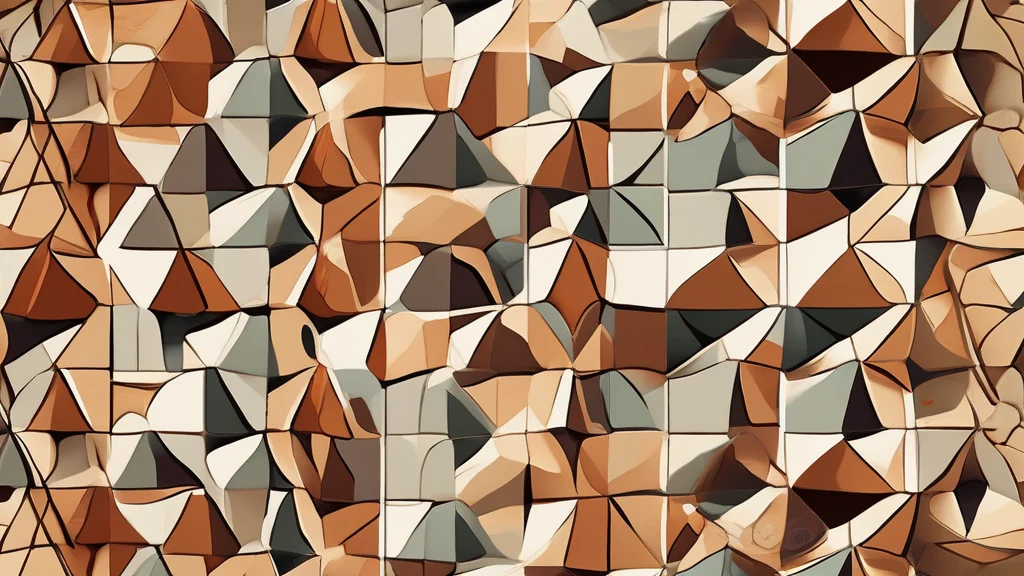
What does tessellation mean?
A tessellation is a pattern of shapes arranged so that they cover a surface without leaving gaps or overlapping. The shapes may be geometric figures such as triangles, squares, or hexagons, and they can repeat regularly or form a more complex design. In mathematics, tessellation is studied as a way of dividing a plane or another surface into connected pieces. The same idea appears in architecture, ceramics, paving, textiles, and digital design, where repeated tiles or units create a unified decorative surface. The word can refer both to the process of forming such an arrangement and to the finished pattern. Tessellation is useful because it describes not merely repetition, but the precise relationship between pieces that fit together seamlessly. Its associations with order, symmetry, craftsmanship, and mathematical beauty make it a particularly vivid term for designs that cover a space with striking regularity.
nounA pattern or arrangement of shapes that fit together without gaps or overlapping, especially one made from repeated geometric tiles. The term is also used for the process or result of forming such a pattern.
- The covering of a surface with shapes or tiles arranged so that they fit together without gaps or overlaps.
- The resulting geometric pattern or arrangement, whether in mathematics, architecture, art, or design.
"The architect used a triangular tessellation to create a striking geometric façade."
"A repeating tessellation of hexagons covers the floor."
"The researcher studied how tessellations change when individual tiles are reflected."
Used when referring to multiple tessellations, distinct patterns, or examples of geometric tiling.
"The exhibit presents several tessellations inspired by Islamic geometric design."
A tessellation is the mathematical art of making a surface fit together perfectly, one shape at a time.
Reviewed by Deb Chak, Editor. AI-assisted content curated by RJS Tech Solutions LLP.
Where does tessellation come from?
Tessellation comes from Latin tessellāre, meaning “to tile” or “to fit with small tiles,” and is formed from tessera, the Latin word for a small square tile or piece used in a mosaic. The English word developed in the 17th century, initially in the context of arranging small pieces into a patterned surface. Its close relatives include tessera and tessellate, which preserve the same Latin root.
Related word forms
How tessellation is actually used
The word is most common in mathematics, architecture, decorative art, and design. It is usually formal or technical, though it is also understood in general contexts involving repeating patterns.