
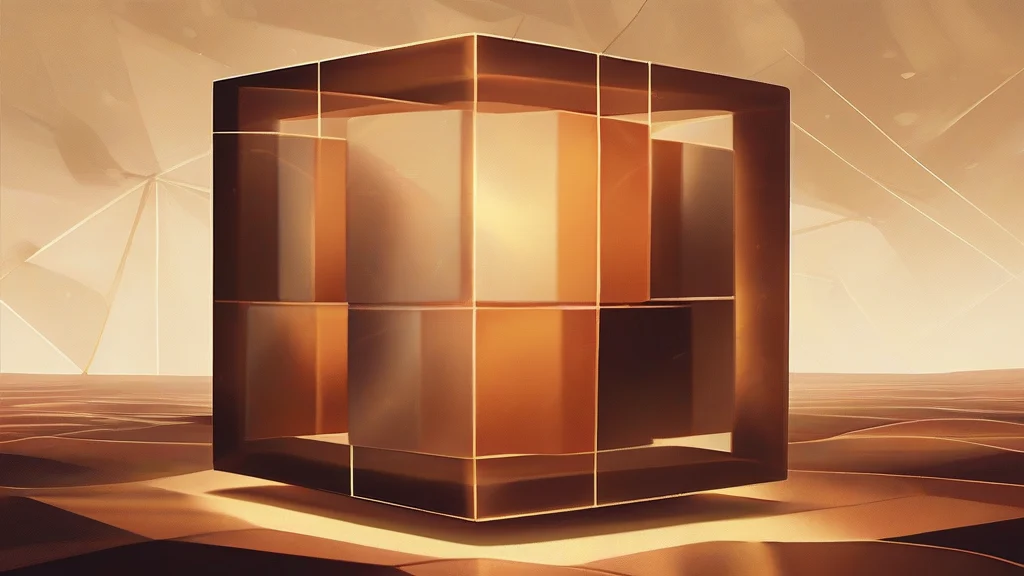
What does tesseract mean?
A tesseract is the four-dimensional analogue of an ordinary cube. Whereas a cube has six square faces, twelve edges, and eight vertices, a tesseract is bounded by eight cubic cells and has 24 square faces, 32 edges, and 16 vertices. Because human vision can perceive only three spatial dimensions, a tesseract is usually represented through a three-dimensional projection, an unfolding, or a sequence of rotating images. The word was coined in the late nineteenth century from Greek elements meaning “four” and “axis” or “ray.” Outside mathematics, it has become especially prominent in science fiction and speculative discussions of space, where it can represent an unfamiliar fourth dimension, a portal, or an impossible structure. The word is useful because it names a precise mathematical object while also providing one of modern culture’s most recognizable images for geometry beyond ordinary physical space.
nounIn geometry, a tesseract is the four-dimensional analogue of a cube, bounded by eight cubic cells. The term is also used for conceptual or speculative models of a fourth spatial dimension.
- The four-dimensional hypercube, bounded by eight cubic cells and regarded as the next geometrical counterpart of an ordinary cube.
- A conceptual or speculative representation of a fourth spatial dimension.
"The animation unfolded the tesseract into a net of eight cubes, making its extra dimension briefly imaginable."
"In four-dimensional geometry, a tesseract has eight cubic cells rather than the cube's six square faces."
"The science-fiction story uses a tesseract as a doorway into a world beyond ordinary three-dimensional space."
The regular plural adds -s when the word functions as a count noun.
"The artist created several tesseracts from wire and translucent fabric."
A tesseract has eight cubic cells, 24 square faces, 32 edges, and 16 vertices.
Reviewed by Deb Chak, Editor. AI-assisted content curated by RJS Tech Solutions LLP.
Where does tesseract come from?
The word was coined in the late nineteenth century by the mathematician H. P. Butler. Its name combines Greek tessares (“four”) with aktis (“axis” or “ray”), via a New Latin form. Its Greek four-related root also connects it with tessera, tessellate, and tessellation.
Related word forms
How tesseract is actually used
The term is chiefly technical in geometry but is widely understood in science fiction, cosmology, and discussions of higher dimensions. In popular usage, it may designate any imaginative model of a fourth dimension rather than the precise geometrical object.