
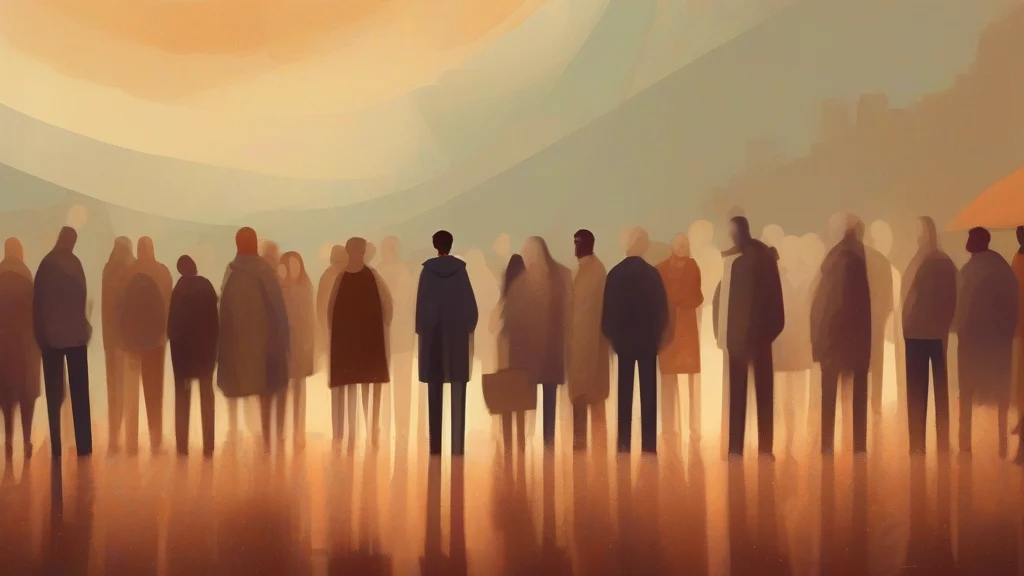
What does thronging mean?
Thronging describes the movement or presence of a large, tightly packed crowd. When used as a verb, it can describe people gathering together, pressing toward a particular place, or moving en masse: spectators thronged the entrance, or commuters thronged through the station. As an adjective, “thronging” commonly describes a street, square, or venue that is full of people and activity. The word is especially effective when it conveys both the size of the crowd and its physical pressure or momentum. It can sound somewhat literary or vivid, so it is well suited to descriptive prose, although it is entirely standard English. “Thronging” is closely related to the noun “throng,” meaning a dense or numerous crowd, and it conveys more motion and activity than that static noun often does.
To gather in or move as a large, dense crowd, especially around a person, place, or event.
"Reporters thronged around the spokesperson as he left the courthouse."
Can be used transitively, with “a person, place, or thing” as its object, or intransitively.
Crowded with people; full of people or activity.
"We avoided the thronging high street and took the quieter route through the park."
Often used before spatial or public-place nouns such as “street,” “square,” or “market.”
A throng is more than a crowd: it is a crowd pressing, surging, and moving together.
Reviewed by Deb Chak, Editor. AI-assisted content curated by RJS Tech Solutions LLP.
Where does thronging come from?
“Thronging” comes from the English verb “throng,” which developed from Old English “þringan,” associated with the meanings “to press,” “to push,” and “to crowd.” The word belongs to a Germanic family of related vocabulary for pressing and crowding, including German “dringen” and Danish “træng.” Its historical sense of physical compression survives in the modern idea of people pressing together in a large crowd.
Related word forms
How thronging is actually used
“Thronging” is standard in both British and American English. It has a slightly literary or old-fashioned quality, but remains natural in descriptive writing. As an adjective, it usually describes a place, street, or area filled with people.