
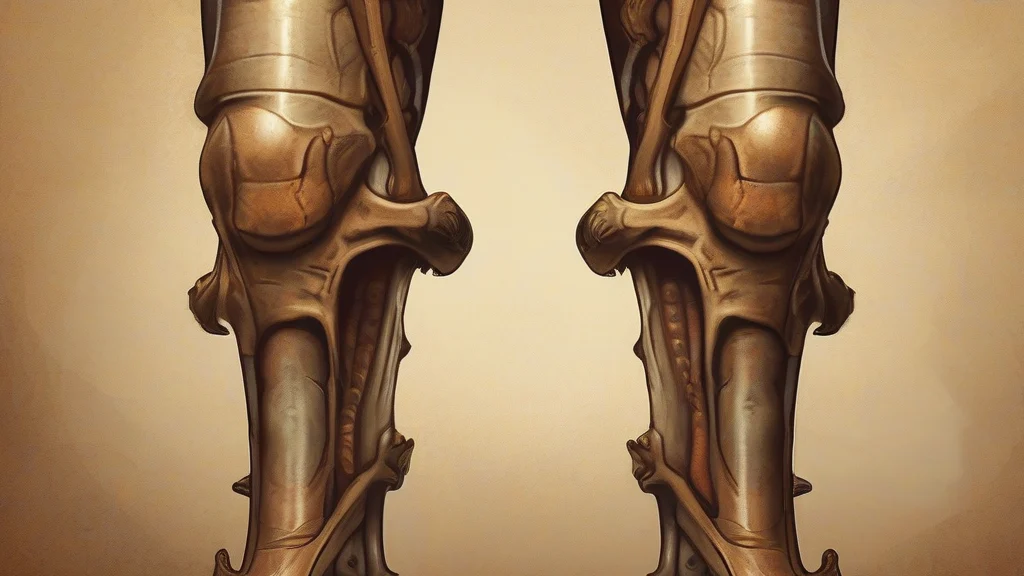
What does tibias mean?
“Tibias” is the plural form of “tibia.” In anatomy, each tibia is the larger and stronger of the two bones of the lower leg, situated on the inner side and forming part of the knee and ankle joints; a person normally has two tibias. In historical and archaeological writing, tibias also refers to tibiae, an ancient Roman type of pipe or reed instrument. The ordinary English plural tibias is fully accepted, while tibiae preserves the traditional Latin plural and is especially familiar in anatomical and classical contexts. In prose, tibias most often appears in clinical or descriptive language about the lower limbs, as in reports of fractures or comparisons of leg bones. Because the underlying word also names a musical instrument, tibias has an unusual double life: it can evoke both the body and antiquity. It is a useful term when anatomical precision matters.
noun (plural)The plural form of tibia, referring to the two larger bones of the lower legs or, in historical usage, to an ancient type of pipe called a tibia.
- The plural of tibia: either of the two larger bones of the lower leg.
- The plural of tibia as the name for an ancient Roman pipe or reed instrument.
"The X-ray revealed fractures in both tibias."
"The scan showed fractures in both tibias."
"The museum's collection includes several tibias recovered from Roman sites."
Tibiae is the conventional plural, following Latin; tibias is also standard and widely used in modern English.
"The radiologist compared the two tibiae."
A tibia is both the shin bone and the name of an ancient Roman pipe—skeletal and musical in one word.
Reviewed by Deb Chak, Editor. AI-assisted content curated by RJS Tech Solutions LLP.
Where does tibias come from?
The word comes from Latin tibia, used both for the shin bone and for an ancient pipe or reed instrument. English adopted the anatomical word directly and also retained its classical musical sense. The traditional plural is tibiae, following Latin, while tibias is an established English plural.
Related word forms
How tibias is actually used
Tibias is most common in clinical, anatomical, and archaeological writing. In the anatomical sense, “shin bones” is usually clearer in general speech. The musical sense belongs chiefly to historical, archaeological, and organological contexts.
Easily confused with tibias
Tibiae is the traditional Latin-style plural of tibia, while tibias is an equally established English plural.