
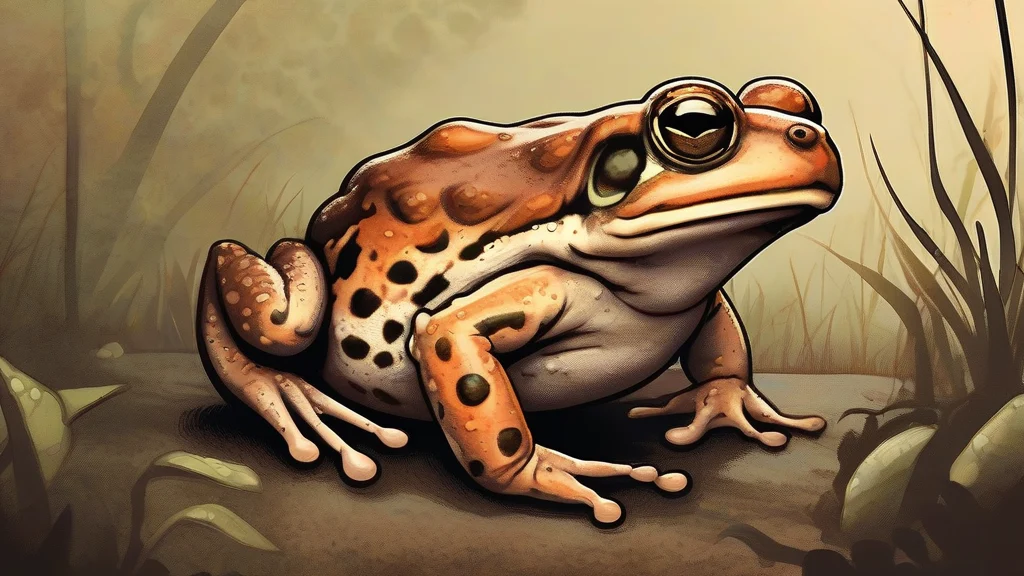
What does toad mean?
Toad most commonly names a type of amphibian related to frogs, especially the warty-skinned members of the family Bufonidae. Toads are generally squat, short-legged animals with dry skin and conspicuous glands behind the eyes; many species produce defensive toxins, although their habits and toxicity vary considerably. In formal biological usage, “toad” denotes a member of Bufonidae rather than every animal popularly described as a frog or toad. The word also has a long-established derogatory meaning for a contemptible or detestable person. In that sense, and in the related informal verb meaning to insult or mock someone contemptuously, it conveys strong disapproval and can sound deliberately blunt or theatrical. Familiar expressions include the dish “toad in the hole.” Although once used more broadly for frogs and frog-like animals, the modern word refers most specifically to the characteristic members of the toad family. Its vivid physical associations and strongly negative figurative use make it memorable both as an animal name and an insult.
Any of various short-legged amphibians in the family Bufonidae, typically having dry, warty or glandular skin. In informal derogatory use, a toad is a contemptible or detestable person.
"The toad swallowed a beetle beneath the damp leaves."
The animal sense is neutral. The personal-insult sense is informal, derogatory, and potentially insulting.
To insult, mock, or address someone contemptuously.
"Newspapers were quick to toad the politician after the disastrous speech."
This verb is informal and strongly derogatory; it is less common than the noun's animal sense.
The standard plural is formed by adding -s.
"Several toads appeared near the garden pond after dark."
Toads are true frogs in the family Bufonidae, and many of them can defend themselves with toxins released from glands behind their eyes.
Reviewed by Deb Chak, Editor. AI-assisted content curated by RJS Tech Solutions LLP.
Where does toad come from?
The English noun comes from Old English tade, an Old English name for a frog-like amphibian. It is generally traced to a Proto-Germanic root represented in related Germanic vocabulary and also underlies the English words tad and tadpole. The compound toadstool developed from the animal's name because certain mushrooms were thought to resemble toads, while the modern insulting sense arose from comparisons with an ugly or distasteful animal.
Related word forms
How toad is actually used
The animal sense is neutral and standard in both British and American English. The personal-insult sense and the verb are informal and strongly derogatory, sometimes carrying a theatrical or deliberately archaic tone.
Easily confused with toad
A toad is technically a frog in the family Bufonidae, generally distinguished by stockier proportions and drier, warty or glandular skin, while “frog” is the broader everyday term.
A toad is an adult amphibian, whereas a tadpole is the aquatic larval stage of a frog or toad.