
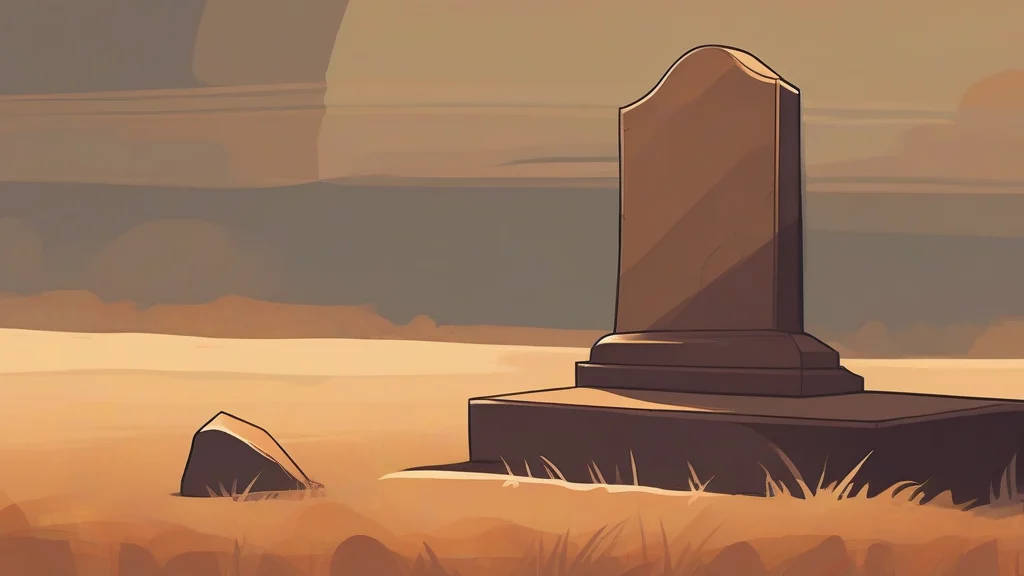
What does tombstone mean?
A tombstone is a stone or slab that marks a grave and commonly records the deceased's name, lifespan, or epitaph. The term is used in British, American, and other English-language varieties, with gravestone and headstone serving as close alternatives. In everyday contexts, tombstone imagery conveys mourning, remembrance, permanence, and the passage of time. Writers may also use it figuratively for something that remains as a reminder after a person, place, or institution has disappeared. In distributed computing, a tombstone is a marker indicating that data has been deleted; retaining such markers can help separate database replicas recognize deletions correctly. The word is therefore both a concrete object associated with burial and a piece of technical terminology. It is especially useful in discussion of cemeteries, epitaphs, genealogy, memorial culture, and data management, where its associations with finality and what survives after departure are central.
nounA tombstone is a stone or slab serving as a marker at a grave, typically inscribed with the deceased's name, dates, or an epitaph. In computing, the term can also denote a deletion marker retained in a distributed data system.
- A stone or slab marking a grave, often bearing the deceased's name, dates, and epitaph.
- In computing and distributed databases, a marker indicating that data has been deleted or is no longer current.
"The oldest tombstone in the cemetery bears a date from the early nineteenth century."
"Volunteers cleaned moss from the cemetery's oldest tombstone."
"The database temporarily retains a tombstone so that other replicas can recognize the deletion."
The regular plural adds -s to form tombstones.
"The guide discusses the inscriptions on the cemetery's tombstones."
An epitaph is one of history's oldest forms of a very short post—and some were carved to last.
Reviewed by Deb Chak, Editor. AI-assisted content curated by RJS Tech Solutions LLP.
Where does tombstone come from?
The compound tombstone appeared in English in the early 17th century, combining tomb and stone. Tomb came through Anglo-French from Latin tumba and ultimately from Greek tymbos, associated with burial and burial mounds. The Latin cognate tumulus, meaning a mound or tomb, belongs to the same Greek root.
How tombstone is actually used
In its literal sense, the word is generally neutral and solemn, though it often evokes mourning, remembrance, and the passage of time. Its technical use in distributed computing is specialized and carries associations of deletion, finality, and temporary retention.
Easily confused with tombstone
The terms overlap, but gravestone is often treated as the broader conventional term, whereas tombstone often emphasizes a slab-shaped memorial stone.
A turnstone is a small shorebird, not a grave marker.