
What does tortoise mean?
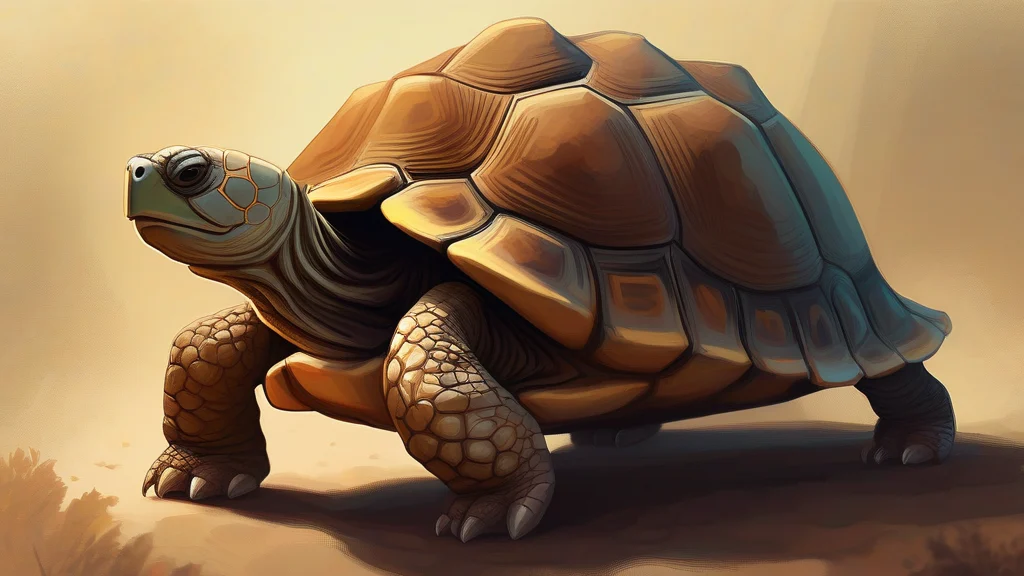
Tortoise denotes a land-dwelling reptile with a hard, domed shell, stout legs, and a reputation for moving slowly. It most often refers to members of the family Testudinidae, including familiar species such as the Galápagos tortoise, Hermann's tortoise, and the Aldabra giant tortoise. In general contrast, a turtle is usually aquatic or sea-going, though the terminology is not perfectly absolute and has changed over time. The word can also be used figuratively for a very slow-moving person, a sense now considered dated and sometimes teasing or disparaging. Tortoises are noted for their longevity, slow metabolism, and remarkable ability to survive long periods with little food or water. Their shells are integral parts of their skeletons rather than removable coverings. In cultural writing, the tortoise often symbolizes endurance, patience, age, and unhurried persistence.
A terrestrial shelled reptile of the family Testudinidae, usually with a domed shell and heavy, scale-covered feet.
"The tortoise slowly crossed the garden."
The figurative noun, meaning a slow-moving person, is dated.
To move slowly or make slow progress.
"Traffic began to tortoise through the snowbound streets."
Rare and informal; more often encountered in British and South Asian English than in standard American usage.
The regular plural of the noun.
"Several tortoises grazed beside the shrubs."
A tortoise cannot leave its shell behind: the shell is part of its skeleton, not a coat it can wear or shed.
Reviewed by Deb Chak, Editor. AI-assisted content curated by RJS Tech Solutions LLP.
Where does tortoise come from?
English tortoise entered Middle English from an Anglo-French and Old French form, tortue, which was borrowed from Medieval Latin tartaruga. The ultimate origin of the Latin word is uncertain, so stronger claims about its deeper etymology should be avoided. English turtle has a closely related French and Latin history, while the modern French tortue, Spanish tortuga, and Portuguese and Italian tartaruga are Romance relatives of the same medieval Latin form.
Related word forms
How tortoise is actually used
In ordinary modern usage, tortoise refers literally to the terrestrial reptile. Calling someone a tortoise is old-fashioned and can be mildly disparaging. The verb tortoise is rare and informal.
Easily confused with tortoise
A tortoise is generally a land-dwelling reptile, whereas a turtle is typically aquatic or sea-going, although the terms overlap historically and in some regional usage.