
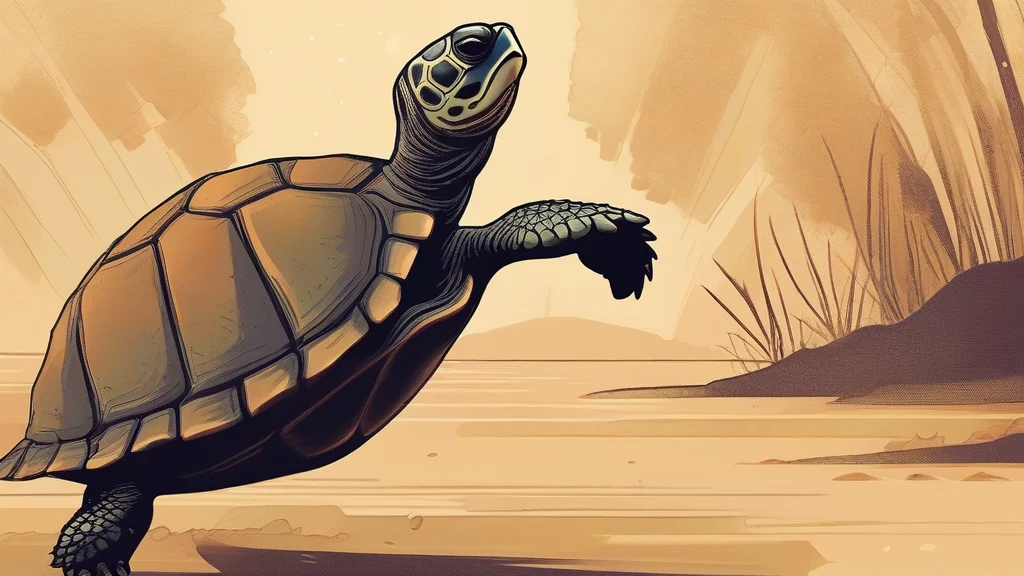
What does turtle mean?
A turtle is a reptile with a distinctive bony shell, four limbs, and a broad head. The word includes sea turtles, freshwater turtles, and, in American English, many terrestrial species that British speakers often call tortoises. Turtles are familiar as symbols of patience, longevity, and slow movement, although their behaviors vary greatly: some migrate thousands of miles, while others defend themselves aggressively. The word can also refer to turtle meat or turtle soup, a dish now often prepared with substitutes. As a verb, to turtle means to move or proceed slowly and laboriously. In ordinary conversation, turtle is also occasionally used as an informal metaphor for someone or something perceived as unhurried. The distinction between turtle and tortoise is especially important in British usage, where turtle usually denotes an aquatic animal and tortoise usually denotes a land animal.
A reptile with a bony shell, four limbs, and a broad head. The term includes aquatic and, especially in American English, terrestrial species.
"The turtle basked on a rock beside the pond."
To move or work slowly and laboriously.
"The heavy truck turtled up the hill."
Chiefly informal and used to describe conspicuously slow movement.
The standard plural of the noun turtle.
"Several turtles crossed the path."
A sea turtle can cross an entire ocean, yet it still returns to land to lay its eggs.
Reviewed by Deb Chak, Editor. AI-assisted content curated by RJS Tech Solutions LLP.
Where does turtle come from?
The English word turtle comes through Old French tortue from Medieval Latin tartaruga. Its ultimate origin is uncertain, and the connection between the Latin word and the ancient name for the animal is not fully clear. English also has tortoise, a related word reflecting the same broad French and Latin tradition, while turtle dove, turtleshell, and turtleneck are later English formations based on the turtle.
Related word forms
How turtle is actually used
In American English, turtle can refer to both aquatic and terrestrial turtles, while British English more consistently distinguishes turtles from tortoises. The verb turtling is informal and conveys slow, difficult, or laborious movement.
Easily confused with turtle
A tortoise is generally a land-dwelling turtle, whereas a turtle may live on land or in water; in British English, turtle usually means an aquatic reptile.