
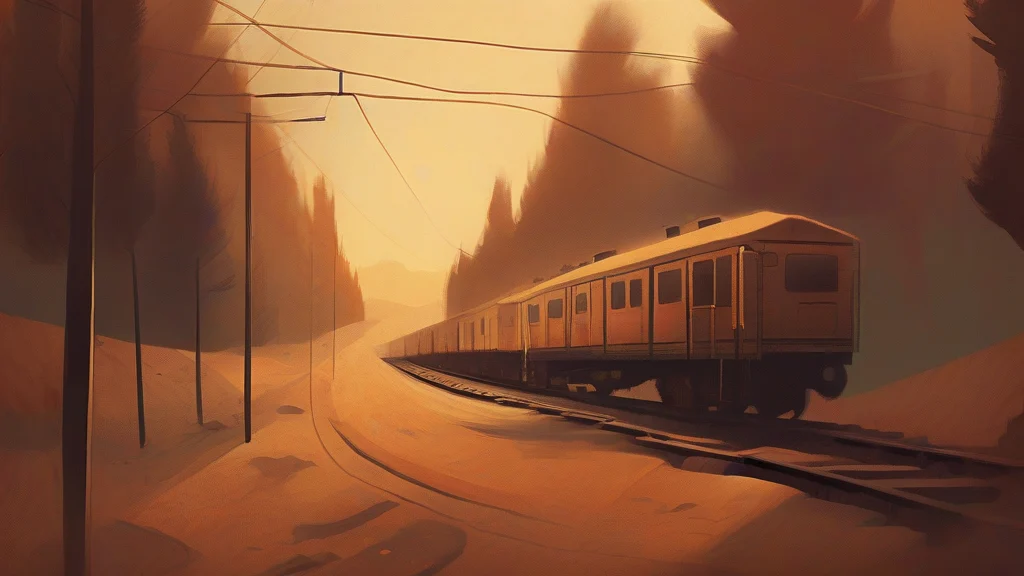
What does trackless mean?
Trackless is an adjective meaning “without tracks or paths.” It most often describes remote or wild country in which no trail, road, or other guide to the route can be followed. The word can also be applied more narrowly to a vehicle or system that does not run on rails. Because these uses are specialized, trackless has a slightly literary, uncommon feel in modern English, and pathless is often the more familiar alternative. Its power lies in evoking not merely the absence of a marked path but the uncertainty and difficulty of finding one. In descriptions of wilderness, moorland, or forest, it suggests terrain that resists easy navigation. The word belongs to English’s productive -less pattern: countless adjectives combine this suffix with a noun to form a precise negative term meaning “without” the thing named. In that respect, trackless is both practical and memorable.
adjectiveHaving no tracks, paths, or visible route; describing country that is wild, unmarked, or difficult to travel across. It can also mean not fitted with or running on rails.
- Without tracks, paths, or other traces of a route; unmarked and often difficult to travel across.
- Not fitted with or running on rails.
"Beyond the last hamlet lay a trackless expanse of moor, where no path marked the way onward."
"The expedition spent several days crossing a trackless region of northern forest."
"The museum's trackless tram carried visitors along the route of the former railway."
No rails required: trackless can describe both wild country with no path and a vehicle that never touches rails.
Reviewed by Deb Chak, Editor. AI-assisted content curated by RJS Tech Solutions LLP.
Where does trackless come from?
Trackless is an English compound formed from track and the productive suffix -less, meaning “without” or “lacking.” Its core noun descends through Middle English from an Old English Germanic word associated with a trail or trace, while the compound has been in use since the 17th century. Forms such as tracked and tracking retain the same core word; trackless itself reflects the familiar English pattern of adding -less to form a word denoting absence.
Related word forms
How trackless is actually used
Trackless is relatively uncommon and often has a literary or specialized tone. In general use it usually describes terrain without paths or roads, whereas the railway sense is narrow. Pathless is a more common near-synonym, while trackless often adds a suggestion of remoteness or navigational difficulty.
Easily confused with trackless
Trackless means lacking paths, tracks, or rails, whereas tackless means lacking dexterity, skill, or effective resources.