
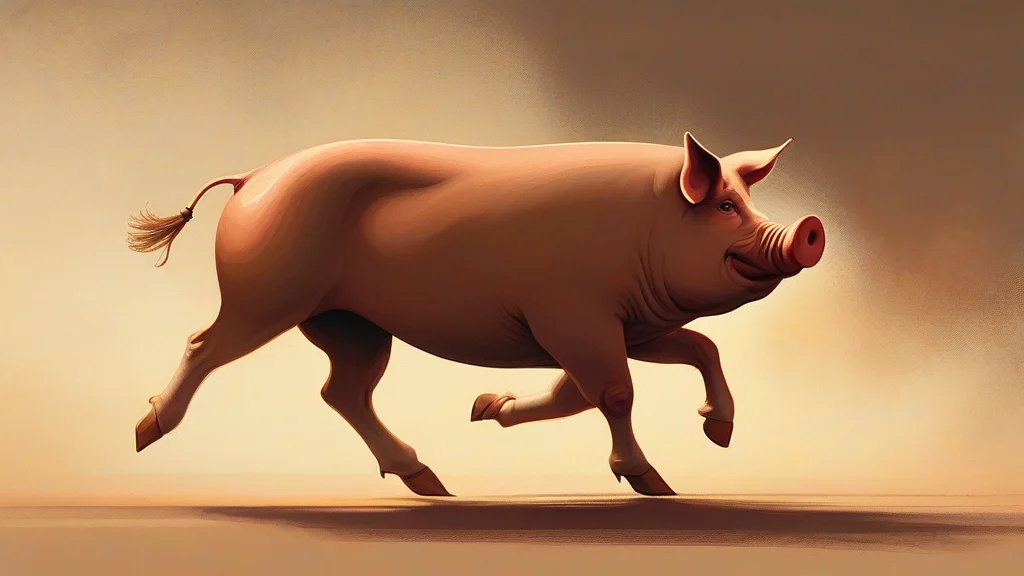
What does trotter mean?
Trotter most commonly denotes a horse bred and trained to move at a trot, particularly a harness-racing horse. A trot is a brisk, two-beat riding gait, faster than a walk but slower than a canter or gallop. The word can also refer to a person who trots or jogs, though this use is often playful rather than formal. As a verb, trot describes moving with short, light, quick steps, as in a person jogging along a path or a rider taking a horse around a track. It can also be transitive when someone rides or leads an animal at a trot. The vocabulary is especially associated with harness racing, where a trotter's speed, endurance, and controlled stride are central qualities. More broadly, the word conveys steady forward movement that is quicker than walking but not hurried or frantic.
A horse trained to move at a trot, especially one used in harness racing; also, less commonly, a person who trots or jogs.
"The trotter settled into its stride halfway around the track."
The horse-racing sense is standard terminology; the sense referring to a person is usually informal.
To move with short, quick steps at a pace faster than a walk, or to cause or ride an animal in that gait.
"She trotted the pony back to the stable."
The intransitive use is common in descriptive and narrative writing.
The regular plural is used for both horses and people.
"Several well-bred trotters competed in the evening heats."
The trotter's distinctive diagonal, two-beat stride is faster than a walk but slower than a canter or gallop.
Reviewed by Deb Chak, Editor. AI-assisted content curated by RJS Tech Solutions LLP.
Where does trotter come from?
The noun and verb forms were formed in English from the established verb trot and the agentive or verbal suffix -er, originally indicating a person or animal that trots. The deeper origin of trot is uncertain, although it is often linked with Germanic forms found in Old Norse and Old High German. Related forms appear in other European languages, including French trotter and Italian trottare, while trottoir reflects the same lexical family through French.
Related word forms
How trotter is actually used
In horse-racing terminology, the word is precise and standard. When applied to a jogger or runner, it is often informal and mildly humorous. As a verb, it has a plain, often gently descriptive quality.
Easily confused with trotter
A trot is the gait itself, while a trotter is a horse or person that moves in that gait.