
What does trotting mean?
Trotting means moving at a brisk, even pace, usually faster than a walk but slower than a run. For horses, it has a more specific meaning: the two-beat diagonal gait in which the legs move in pairs. A person can also trot, especially when moving quickly without running. As a noun, trotting most often refers to the sport of harness racing, in which a horse pulls a two-wheeled sulky at a trot. The word is familiar in both British and American English, although its sporting sense is more strongly associated with North America, Australia, New Zealand, and parts of Europe. In everyday conversation, “trotting along” can suggest steady, comfortable progress rather than hurried movement. Because a trot combines speed with control and regularity, it also gives the word a rhythmic, energetic character. In horse-racing vocabulary, however, trotting is precise rather than merely descriptive: it identifies a particular gait with a sequence of diagonal footfalls distinct from a pace or canter.
To move at a brisk, even pace between walking and running, or to ride or lead a horse at a trot.
"The young horse trotted calmly around the arena."
For horses, this refers specifically to a two-beat diagonal gait.
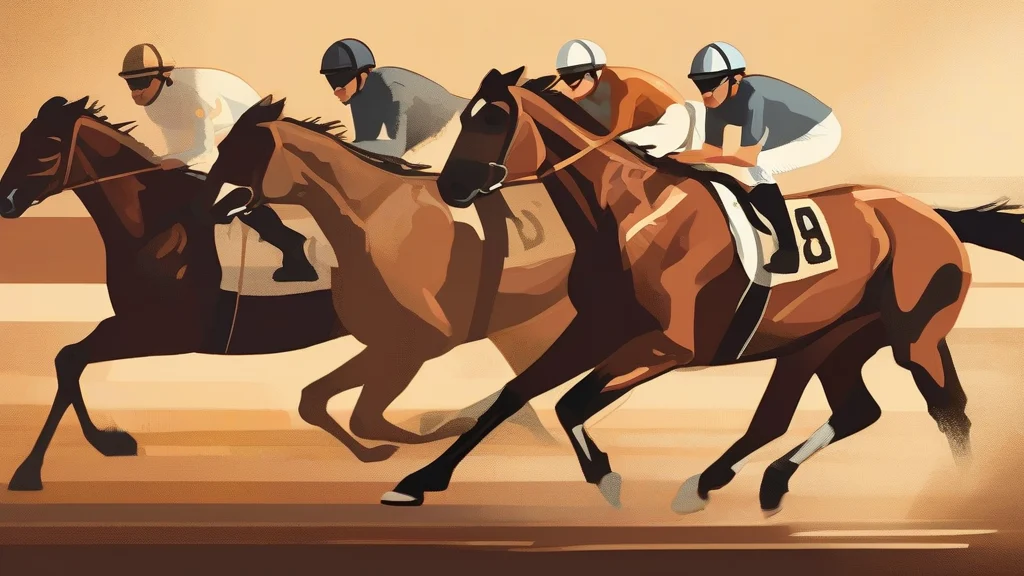
The action or sport of trotting, especially harness racing with horses pulling sulkies at a trot.
"Trotting attracts spectators who follow the closely contested races at the local track."
Moving at or participating in a trot.
"The trainer watched the trotting colt with great interest."
This use is usually attributive or participial, as in “trotting horse.”
When referring to the gait or the sport, trotting is normally a mass noun and has no standard plural.
"The trotting began before the gates opened."
In trotting, the horse's diagonal leg pairs create a two-beat rhythm fast enough to power a sulky around the track.
Reviewed by Deb Chak, Editor. AI-assisted content curated by RJS Tech Solutions LLP.
Where does trotting come from?
The word comes through Middle English troten, from Old English trottan, meaning “to trot.” It belongs to a Germanic vocabulary for a horse's brisk gait, reflected in related forms in languages such as Dutch and German. Modern English also uses trotting as a noun, particularly for the form of harness racing conducted at a trot.
How trotting is actually used
The verb, participle, and attributive adjective are neutral in register. As a noun, trotting is established in British and American racing vocabulary and is particularly associated with the sport of harness racing.