What does galloping mean?
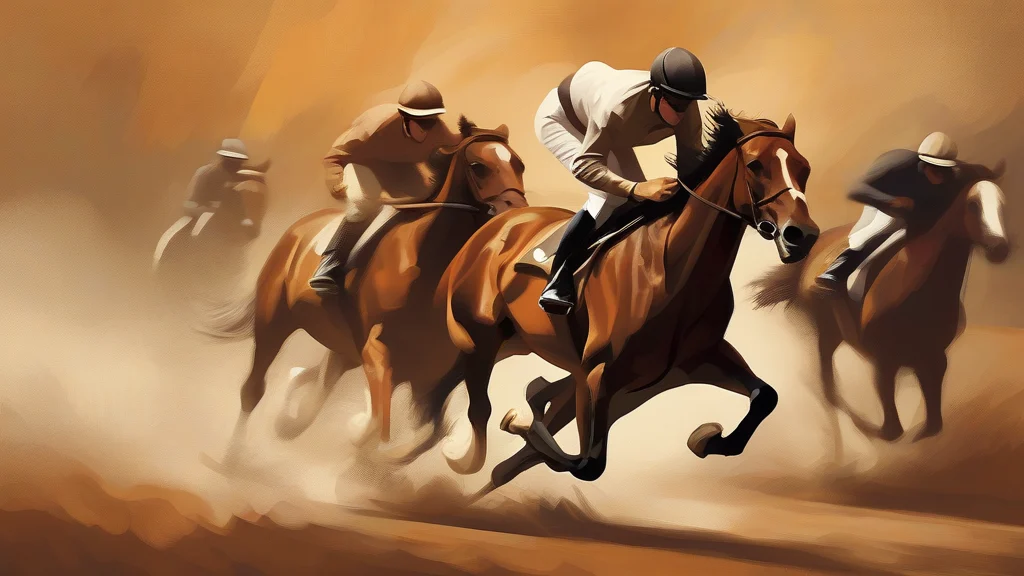
Galloping is the present participle of the verb 'to gallop', describing movement at the fastest natural gait of a horse, in which all four hooves leave the ground during each stride. It applies literally to horses and their riders, and figuratively to anything moving or growing with headlong, uncontrolled speed. This figurative sense gives English some memorable pairings: economists speak of 'galloping inflation' to describe price rises spiralling beyond control, and nineteenth-century physicians used 'galloping consumption' for tuberculosis that advanced with terrifying swiftness. The word therefore carries a vivid connotation of urgency and runaway momentum rather than mere quickness. In everyday speech it most often appears in progressive verb forms such as 'came galloping' or 'was galloping', evoking thundering hooves and open country. Derived ultimately through Old French from a Germanic root, it remains one of the most kinetic words in the language, instantly conjuring speed, power, and wildness.
Present participle of gallop: to move at a horse's fastest gait, or (of a rider) to cause a horse to do so.
"They were galloping along the beach at sunset."
Typically used in progressive tenses and figurative extensions ('rumours came galloping through the office').
Proceeding or spreading at an excessive, uncontrolled rate.
"The country struggled under galloping inflation."
Almost always figurative; classic collocations include 'galloping inflation' and the historical 'galloping consumption'.
The action or act of galloping.
"The galloping of the horses echoed across the valley."
Gerund or verbal-noun use; far less common than the verb form.
In the 19th century, 'galloping consumption' was the terrifying name for tuberculosis that killed its victims within months — the horse metaphor doing grim work in medicine.
Reviewed by Deb Chak, Editor. AI-assisted content curated by RJS Tech Solutions LLP.
Etymology of galloping
The word traces back to the verb 'gallop', which entered English from Old French 'galoper' (noun 'galop'), a term of Germanic origin, plausibly from a Frankish compound meaning roughly 'to run and leap'. English later re-borrowed related French forms, notably 'galop', the name of a lively 19th-century round dance, and 'gallopade', another spirited dance of the same era. The figurative uses — 'galloping inflation', 'galloping consumption' — arose by extending the horse's fastest pace to any rapid, unstoppable advance.
How galloping is actually used
As a verb form, 'galloping' appears chiefly in progressive constructions ('is galloping', 'was galloping'). Its figurative adjectival sense carries a strong connotation of urgency and lack of control, most famously in economics ('galloping inflation') and older medical writing ('galloping consumption'); in these uses it implies something dangerously out of control rather than merely fast.
Easily confused with galloping
Gallivanting means roaming about in search of pleasure or amusement, while galloping refers either to a horse's fastest gait or, figuratively, to rapid and uncontrolled spread or growth.