What does gallopade mean?
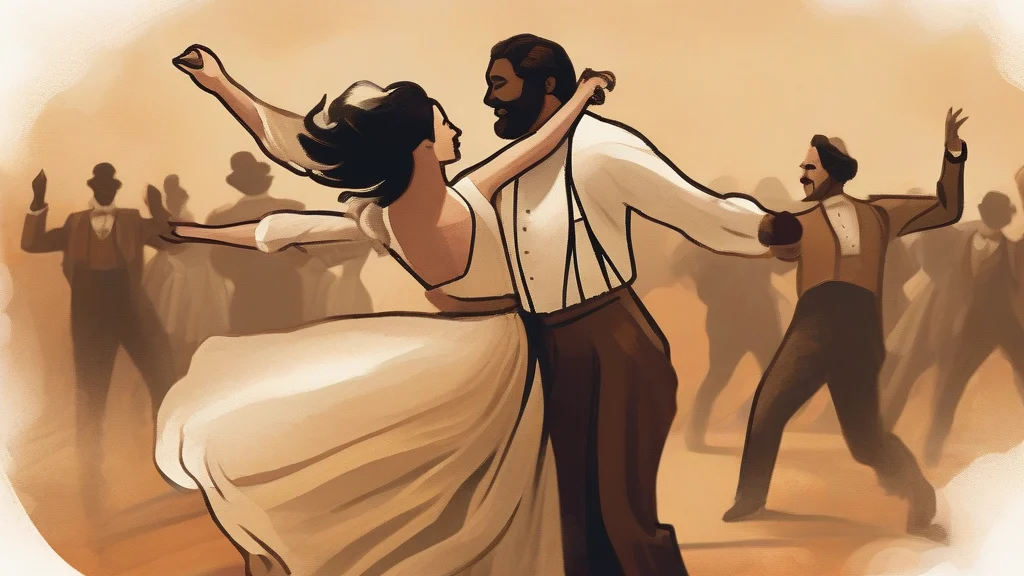
The gallopade is a lively ballroom dance that flourished in Europe and America during the early-to-mid nineteenth century, danced by couples in rapid duple meter with running, gliding steps that gave it the character of its namesake, the horse's gallop. It emerged from the same craze for fast couple dances that produced the galop, and it was often performed as a concluding figure of larger ballroom sets such as the quadrille. The word also refers to a piece of music composed in the dance's brisk rhythm, and composers wrote gallopades for both the ballroom and the salon. Contemporary commentators found its speed almost indecorous, which only added to its popularity. Today the term appears mostly in dance history, period fiction, and performances by ensembles specializing in nineteenth-century repertoire, making it a useful word for readers interested in the social customs of the era.
nounA lively couple dance of the 19th century performed in galop time, marked by rapid gliding steps; also a piece of music written for this dance.
- A lively 19th-century ballroom dance for couples, performed with rapid running or gliding steps in duple meter.
- A musical composition in the rhythm and tempo characteristic of this dance.
"The ball opened with a spirited gallopade that swept every couple across the floor."
"The orchestra struck up a gallopade and the dancers flew around the ballroom in breathless circles."
"Her latest piano album includes a charming gallopade inspired by Viennese ballroom music."
Standard plural; used when referring to multiple dances, pieces of music, or instances of the dance.
"The programme featured two gallopades between the waltzes."
When the gallopade swept European ballrooms in the 1820s and '30s, critics condemned it as scandalously fast — couples whirled at a pace closer to a horse race than a dance.
Reviewed by Deb Chak, Editor. AI-assisted content curated by RJS Tech Solutions LLP.
Etymology of gallopade
The word gallopade comes from the French 'galopade', itself derived from 'galop', the French term for the horse's gallop, which also gave English the verb 'to gallop'. The dance and its name spread from France and central Europe into England and America in the early nineteenth century, when fast couple dances became fashionable. Its cognates include the galop, the closely related quick dance, and the common English word 'gallop'.
How gallopade is actually used
A historical term now encountered mainly in discussions of 19th-century dance, music history, and literature of the period; in modern use it survives chiefly in early-music and vintage-ballroom contexts.
Easily confused with gallopade
The galop is the simpler, faster German-French couple dance of the same family, while the gallopade was a longer figure-based ballroom dance set to galop-like music.