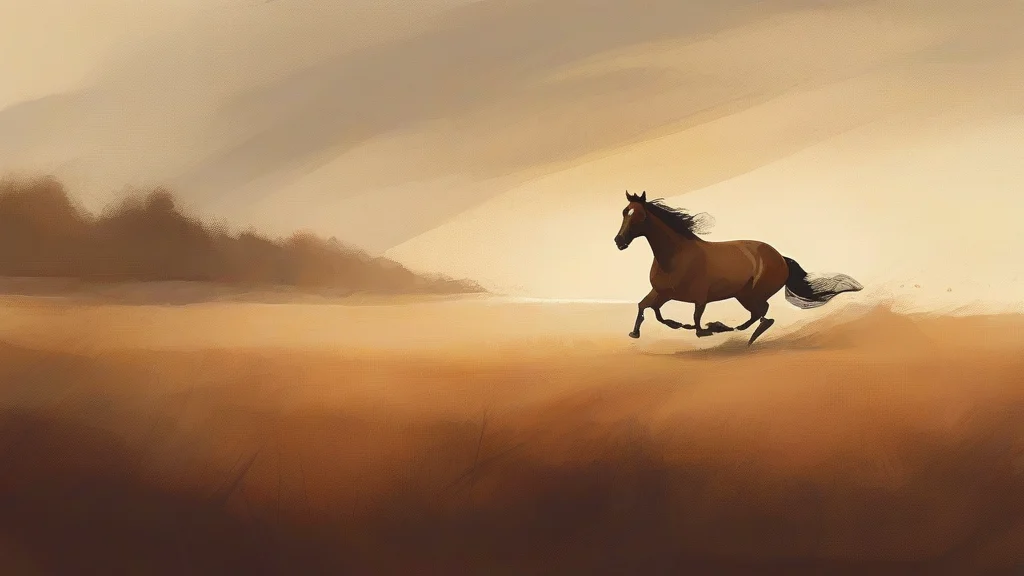
What does gallop mean?
Gallop is the fastest natural gait of a horse: a powerful, four-beat running pace so vigorous that, at the height of each stride, all four hooves leave the ground at once. The word works both as a noun — 'the horse shifted from a canter into a gallop' — and as a verb, meaning to ride or move at that pace. Beyond the stable, gallop carries a productive figurative life: readers gallop through a novel, lecturers take a gallop through the syllabus, and composers mark passages to be played 'at a gallop'. In each case the word signals speed, momentum, and a certain exhilarating urgency, though it can also hint at haste that skims over detail. Equestrians distinguish it carefully from the canter, which is slower and smoother. Derived forms such as galloper and the dance known as the gallopade extend its reach, making gallop a vivid word wherever swiftness matters.
The fastest natural gait of a horse, a four-beat run with a period of suspension in which no hoof touches the ground.
"The racehorse covered the final furlong in a full gallop."
Technically distinct from the canter: the gallop is faster and has a four-beat rhythm rather than three.
To ride an animal, or to move oneself, at a galloping pace; figuratively, to proceed very rapidly.
"We galloped across the plain before the storm caught up with us."
As a countable noun, 'gallops' refers either to multiple instances of the gait or, especially in British usage, to exercise rides taken by racehorses on training grounds known as gallops.
"The trainer sends the string out for their morning gallops on the heath."
A galloping horse is briefly airborne — for a split second every stride, all four hooves are off the ground at once.
Reviewed by Deb Chak, Editor. AI-assisted content curated by RJS Tech Solutions LLP.
Etymology of gallop
Gallop entered English from French during the medieval period, adopted alongside the vocabulary of horsemanship that came with chivalric culture. Its Old French source, 'galop', denoted the horse's swiftest pace, though the deeper origin of the French term itself is not securely established. English quickly built derivatives on it, including 'galloper' for a rider or horse moving at speed and, much later, the lively nineteenth-century couple-dance called the gallopade.
Related word forms
How gallop is actually used
In equestrian contexts, 'gallop' has a precise technical meaning distinct from canter — the gallop is faster and has a four-beat rhythm, whereas the canter is slower and three-beat. Figurative uses ('a gallop through the material') convey speed and briskness, sometimes implying haste at the expense of thoroughness. The verb is common both literally, with riders or animals, and figuratively, with people rushing through work or reading.
Easily confused with gallop
Gallup is a surname best known from the Gallup opinion polls and shares a similar spelling, while gallop is the horse's fast gait; the two are entirely unrelated in meaning.