What does galloper mean?
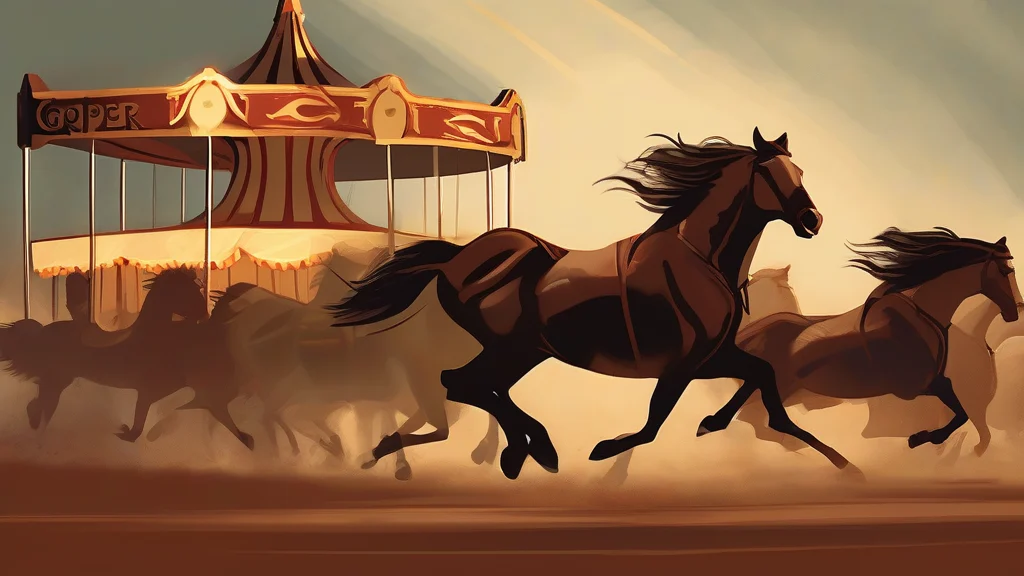
A galloper is a horse moving at a gallop, the swiftest of the natural four-beat gaits, typically one being ridden, driven, or deployed at speed. Historically the term carried strong military associations: cavalry mounts were described this way, and 'galloper guns' — lightweight cannons hauled rapidly between positions by horse teams — took the same name. In Britain the word found a second, more whimsical life at the funfair, where the carved horses of a traditional carousel are affectionately known as 'gallopers', their sculpted mid-air stride evoking perpetual motion. Derived from the older term 'gallop', the word connotes speed, energy, and momentum, and it retains a slightly old-fashioned, traditional flavour today. Though uncommon in everyday conversation, it survives in equestrian circles, historical writing about cavalry and artillery, and heritage fairground culture, making it a useful word for anyone interested in horses, military history, or vintage amusement rides.
nounA galloper is a horse moving at, or ridden at, a gallop — the fastest four-beat gait. The term also commonly denotes the carved horses on a fairground carousel, which are traditionally called 'gallopers' because they appear to gallop as the ride turns.
- A horse that is galloping, especially one ridden or driven at a gallop (as in military, hunting, or racing contexts).
- One of the carved horses on a carousel or merry-go-round, especially in British fairground terminology.
- (Historical) A small, light field gun transported at speed by horses — the 'galloper gun' of 17th–18th century artillery.
"The cavalry galloper swept down the ridge ahead of the rest of the troop."
"The huntsman urged his galloper over the final hedge as the hounds closed in."
"Children queued for their favourite galloper on the restored Victorian carousel."
Standard pluralisation applies; plural use is common when referring to a set of carousel horses.
"All forty gallopers on the Victorian carousel had been freshly repainted."
The hand-carved horses spinning on old fairground carousels have their own name — British showmen call them 'gallopers', because their frozen mid-stride pose makes every ride feel like a full-tilt race.
Reviewed by Deb Chak, Editor. AI-assisted content curated by RJS Tech Solutions LLP.
Etymology of galloper
'Galloper' is an English derivative of 'gallop', the word for the horse's fastest gait, which entered English in the early sixteenth century from Old French 'galop'. The Old French term itself is generally traced to Germanic influence — likely a Frankish word for a horse's running pace — absorbed into French vocabulary. From 'gallop' came the agent-like noun 'galloper', denoting a horse (or later, an object) engaged in galloping, alongside related terms such as the dance-derived 'gallopade'. The name thus reflects the medieval and early-modern world in which mounted speed was central to warfare, travel, and spectacle.
How galloper is actually used
The term is somewhat informal and strongly associated with equestrian and military tradition; the carousel sense is chiefly British, where fairground rides are often simply referred to as 'gallopers'. In modern civilian speech it appears far less often than its parent term 'gallop'.
Easily confused with galloper
'Gallop' refers to the gait itself (or the act of riding it), while a 'galloper' names the horse or object doing the galloping.
'Gallup' is an unrelated surname famous for opinion polls, whereas 'galloper' derives from the equestrian term 'gallop'.