What does galop mean?
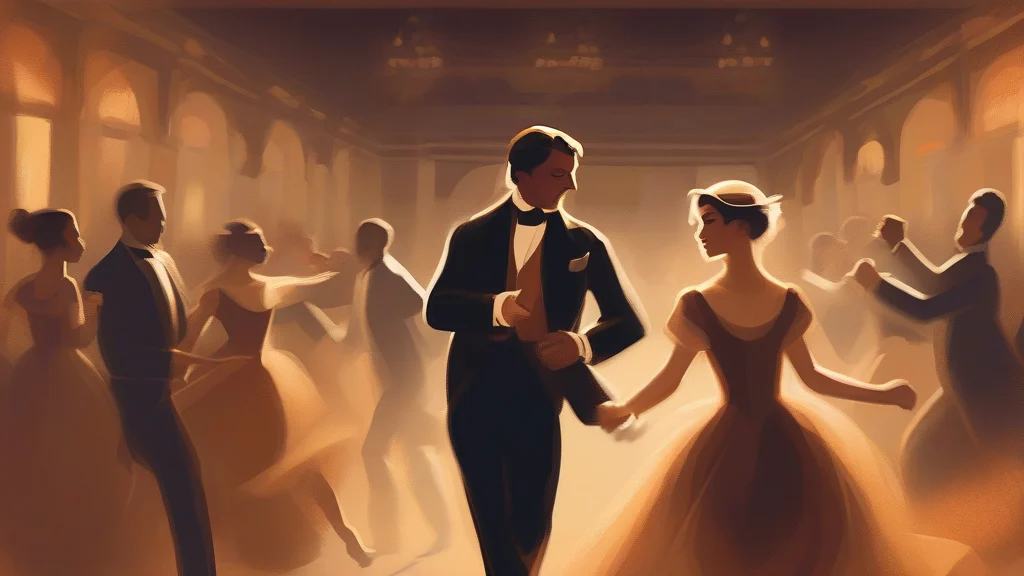
The galop is a quick, spirited ballroom dance performed in 2/4 time, marked by a simple running or gliding step that gives it a sense of headlong momentum. It emerged in France in the early nineteenth century and quickly became a fixture of European ballrooms, where it was conventionally the last dance of the evening — a breathless, exuberant finish that sent couples spinning across the floor before they departed. The name derives from the French word for a horse's gallop, reflecting the dance's driving pace. As well as a dance, 'galop' designates the musical form written for it: a brisk, repetitive piece built on a strong two-beat pulse. Offenbach's famous can-can music is essentially a galop, and composers have continued to write them into the present. Today the word survives chiefly in historical, musical, and ballet contexts, evoking the energy and elegance of the great ballroom era.
nounA galop is a lively ballroom dance in quick duple time (2/4), popular especially in 19th-century Europe, characterized by a gliding, running step. The name also denotes the musical form or piece written to accompany this dance.
- A quick, gliding ballroom dance in 2/4 time, popular in 19th-century Europe, typically danced at the end of a ball.
- A piece of music written in the style and tempo of that dance.
"The ball concluded with a exhilarating final galop that swept every dancer onto the floor."
"The orchestra struck up a galop and the dancers whirled breathlessly around the ballroom."
"Offenbach's can-can music is essentially a galop, driven by its insistent two-beat rhythm."
Standard pluralization; commonly used when referring to multiple dance pieces or performances.
"The program included two galops and a waltz."
The galop was the breathless finale of the 19th-century ballroom — the dance so fast that couples were often forbidden to attempt it until they had proven themselves on slower numbers.
Reviewed by Deb Chak, Editor. AI-assisted content curated by RJS Tech Solutions LLP.
Etymology of galop
The word galop comes directly from the French, where it was borrowed from the verb and noun associated with a horse's fastest gait — the gallop — capturing the dance's breakneck speed. It took hold as the name of a ballroom dance in Paris in the late 1820s and spread rapidly through Europe and America during the nineteenth century. Its English cousin 'gallopade' was an earlier, related dance attempting a similar style. The same Germanic root that gave French its gallop word also underlies the English verbs 'gallop' and related equestrian terms.
How galop is actually used
The word carries a distinctly historical, ballroom-era flavor; it appears mainly in discussions of nineteenth-century dance, ballet, and classical music. In orchestral repertoire the term remains current, as composers still write galops as brisk finale pieces.
Easily confused with galop
Gallop is the fast gait of a horse (and the verb describing it), whereas galop is a quick ballroom dance in duple time — the two share an origin but are distinct words.