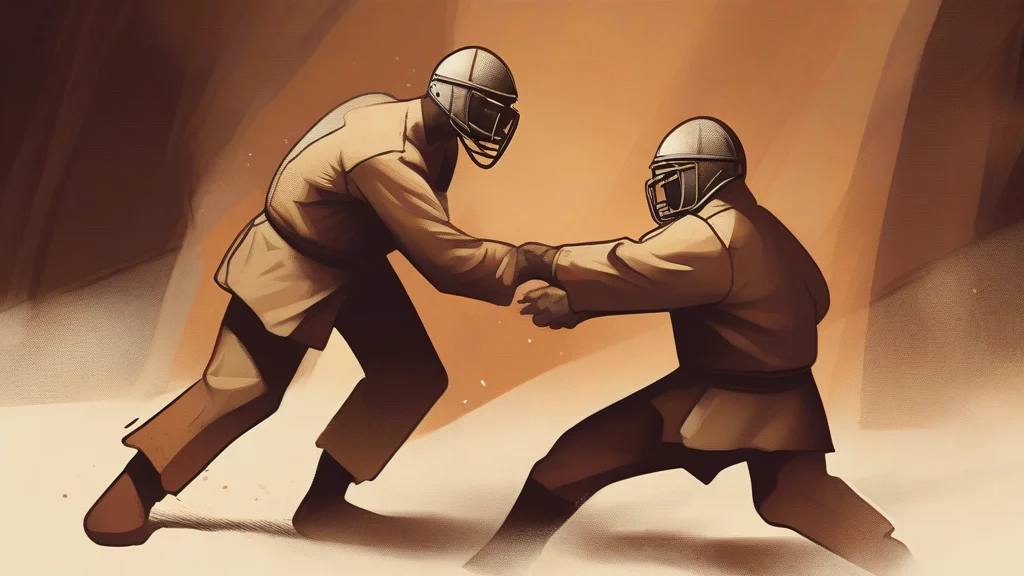
What does tussling mean?
Tussling refers to the act of engaging in a struggle or contest, often in a playful or friendly manner. This can involve physical or verbal sparring, and is often used to describe a lighthearted or humorous competition. The word can be used in both formal and informal contexts, but is more commonly used in informal settings. It is often used to describe a friendly or playful struggle, rather than a serious or intense one. Tussling can be used to describe a wide range of situations, from children playing on a playground to adults competing in a sporting event. Overall, tussling is a useful word for describing a lighthearted or humorous competition, and can add depth and nuance to one's language.
verbTo engage in a struggle or contest, often in a playful or friendly manner.
- To engage in a struggle or contest, often in a playful or friendly manner.
"The two children were tussling on the playground, laughing and trying to get the upper hand."
"The two children were tussling on the playground, laughing and trying to get the upper hand."
"The two friends were tussling over who got to control the TV remote."
The plural form of tussling is used to describe multiple instances of the verb, such as 'the two children were tussling on the playground'.
"The two children were tussling on the playground, laughing and trying to get the upper hand."
Reviewed by Deb Chak, Editor. AI-assisted content curated by RJS Tech Solutions LLP.
Etymology of tussling
The word tussling is derived from the verb 'tussle', which means to struggle or contend. This verb is thought to have originated in the 15th century, and is likely related to the Old French word 'tusler', which means to struggle or fight. The word tussling has been used in English since the 17th century, and has been used to describe a wide range of situations, from physical struggles to verbal sparring.
How tussling is actually used
Tussling can be used in both formal and informal contexts, but it is more commonly used in informal settings. It can also be used to describe a friendly or playful struggle, rather than a serious or intense one.