
What does scuffling mean?
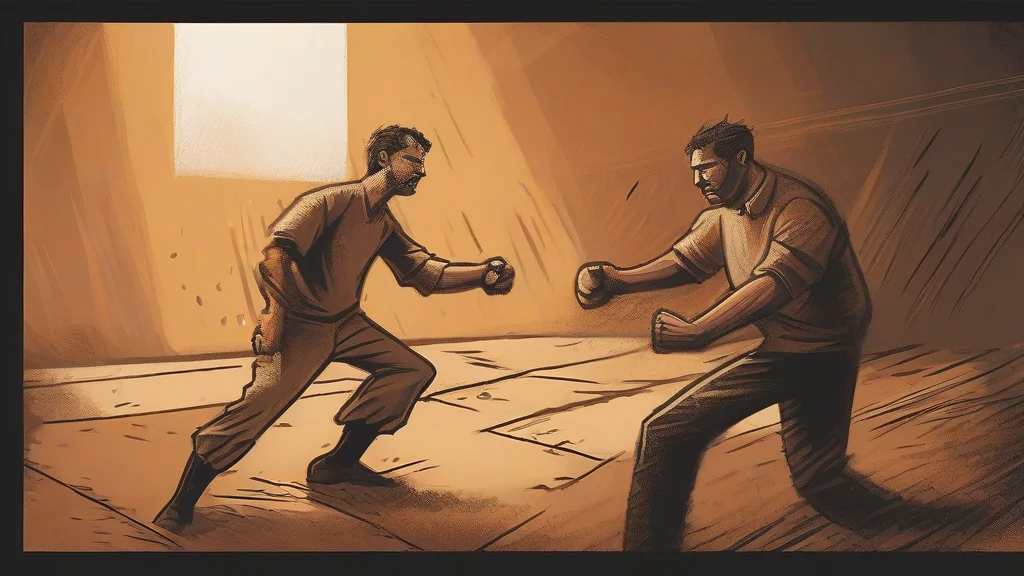
Scuffling describes two related actions. Most commonly, it means moving along with a shuffling, dragging, or scraping step, as when someone's shoes scrape against the floor or a person walks without making a proper lifting motion. This use often carries a mildly comic or disapproving implication: the person may appear reluctant, tired, clumsy, or unconcerned with making a good impression. Scuffling can also mean taking part in a brief, confused physical struggle, especially one involving a jumble of bodies rather than disciplined combat. In that sense, the word appears chiefly in narrative, descriptive, or literary contexts. As an adjective, scuffling describes a sound, movement, or item associated with shuffling, as in “scuffling footsteps” or “scuffling shoes.” As a noun, it can refer to the activity or the audible movement of shuffling feet, though this nominal use is less common than the verbal and adjectival forms.
To walk with a shuffling or scraping movement; also, to engage in a brief, confused struggle.
"The tired child scuffled along beside her mother."
The two senses are distinguished by context: movement with the feet is the dominant modern use, while participation in a brief struggle occurs in narrative or literary language.
Shuffling or scraping, especially with the feet; also engaged in a brief struggle.
"We heard scuffling footsteps in the dark hallway."
This participial use is especially common before words such as feet, shoes, and sounds.
The act or sound of shuffling or dragging the feet; also a brief, confused struggle.
"The sudden scuffling made everyone turn toward the doorway."
The noun is usually used in a mass sense for the action or sound; its use as a countable noun is uncommon.
The countable plural is possible but uncommon; “scuffling” is normally used as a mass noun for the action or sound.
"The brief scufflings ended almost as soon as they began."
One word can conjure both a reluctant shuffle and a sudden flurry of elbows.
Reviewed by Deb Chak, Editor. AI-assisted content curated by RJS Tech Solutions LLP.
Where does scuffling come from?
Scuffling is formed from the verb scuffle by adding the present-participle suffix -ing. Scuffle is a Middle English word of uncertain origin and is commonly linked with shuffle through the shared sense of moving the feet uneasily. Its established meanings include a brief, confused struggle and, by extension, the noisy movement associated with shuffling or dragging the feet.
Related word forms
How scuffling is actually used
The foot-movement sense is informal to neutral and can suggest reluctance, lack of coordination, or weariness. The physical-struggle sense can sound literary or comic and describes a confused, brief contest rather than a formal fight.
Easily confused with scuffling
Scuffing means rubbing or abrading against a surface, whereas scuffling primarily means shuffling one's feet or taking part in a brief struggle.
Shuffling is the broader and more usual term for moving the feet without lifting them clearly, while scuffling often emphasizes a scraping, reluctant, or disorderly movement.