
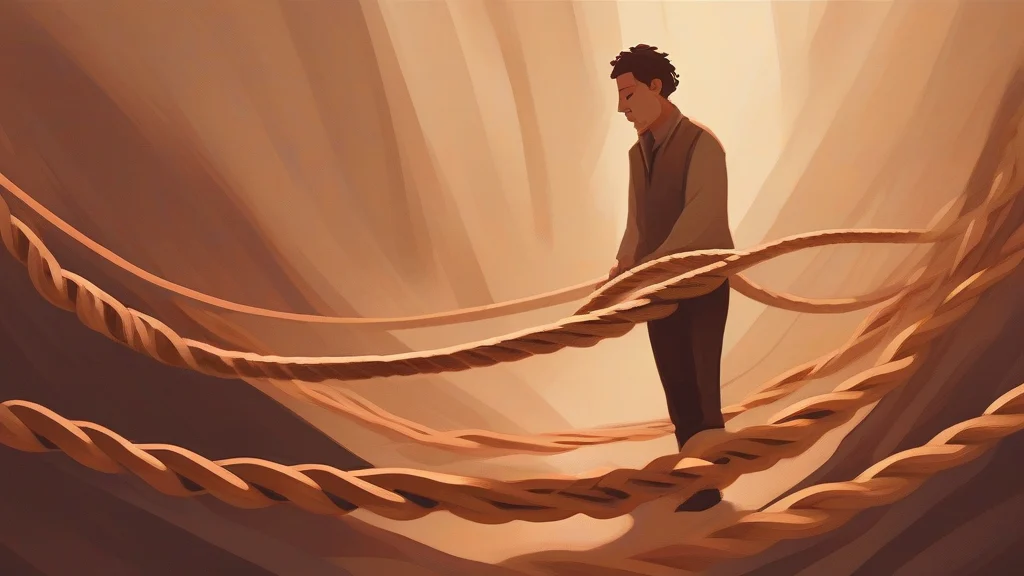
What does uncoiling mean?
Uncoiling is the act of reversing a coiling action, typically by unwinding a rope, spring, ribbon, or other material that has been wound around something. The word is especially evocative because it combines a precise physical meaning with a figurative sense of gradual release. A person may be described as uncoiling after holding their body tense, while a story or situation may involve feelings or pressure uncoiling as tension eases. In descriptive writing, the word suggests movement that unfolds steadily rather than abruptly. Although “uncoiling” can describe a literal object, its metaphorical uses are common and often carry associations of relaxation, freedom, and returning to a natural state. It is used in both British and American English and functions as the present participle of “uncoil” as well as a noun for the process of unwinding.
To unwind or extend something that has been wound up; figuratively, to release tension or restraint gradually.
"The ribbon uncoiled as she pulled the loose end."
As a present participle, “uncoiling” can describe an action in progress and is often used figuratively for the release of tension.
The act or process of unwinding something, or of gradually releasing tension or restraint.
"The uncoiling of the spring sent the mechanism into motion."
The noun is commonly used with “of,” as in “the uncoiling of tension.”
The plural is rare; the uncountable noun form is more common.
"The uncoilings of the ribbons created a tangle on the table."
Uncoiling turns the image of a tightly wound mechanism into a vivid metaphor for release, relaxation, and gradual movement.
Reviewed by Deb Chak, Editor. AI-assisted content curated by RJS Tech Solutions LLP.
Where does uncoiling come from?
“Uncoiling” is formed by adding the prefix “un-” to the established English verb “coil.” “Coil” developed through Middle English and Old French from the Latin root associated with gathering or collecting; its winding meaning became established in English during the early modern period. The prefixed form “uncoil” developed later, expressing the reversal of that action, while related forms such as “coiling” and “coiler” preserve the same verbal root.
Related word forms
How uncoiling is actually used
The word is neutral in register and is especially effective in descriptive or figurative writing. Its physical sense often suggests gradual movement or release rather than a sudden action.
Easily confused with uncoiling
Both words describe reversing a winding action, but “uncoiling” often emphasizes the physical extension or release of something wound up, whereas “unwinding” can also have broader senses involving relaxation or untangling.