
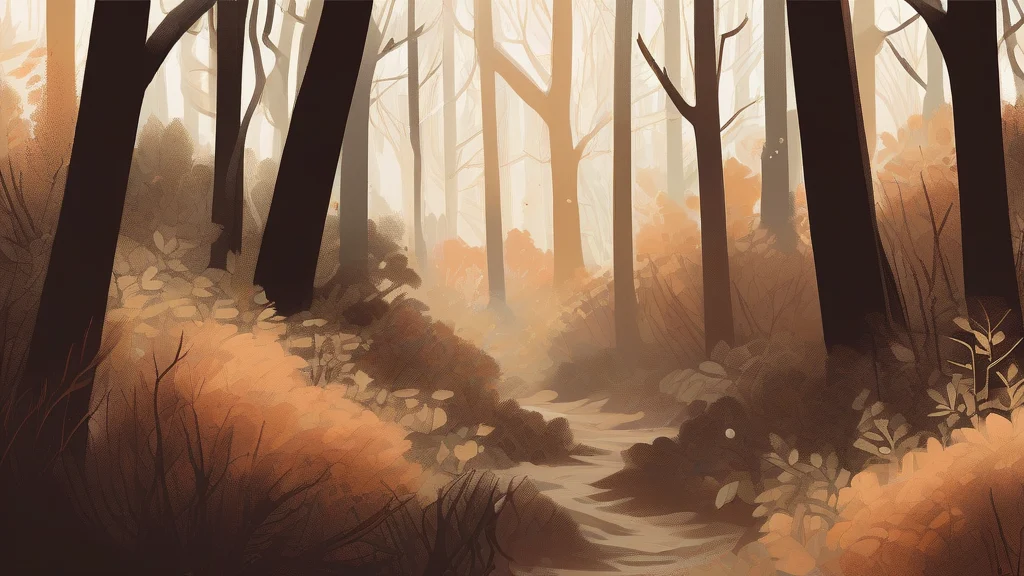
What does underbrush mean?
Underbrush names the low, tangled vegetation that grows beneath trees, shrubs, or other taller plants. It commonly refers to a mixture of brush, saplings, brambles, and young woody plants, especially in woodland or land being cleared for development or agriculture. In everyday North American English, underbrush often carries a visual association of dense, difficult terrain that hides animals, people, or paths. It can also describe vegetation collectively rather than as a countable object, so plural forms are uncommon. Although the noun is much more frequent, underbrush can also be used as a verb meaning to clear ground of underbrush. The word is related to brush, a term for low woody growth, and the prefix under makes its original sense clear: vegetation beneath the main canopy. It is a useful term when the specific layer or location of vegetation matters, rather than simply describing vegetation in general.
Shrubs, brush, and other low woody vegetation growing beneath trees or larger plants.
"The trail disappeared beneath the heavy underbrush."
Usually uncountable and especially common in North American English; in British English, undergrowth is often more usual.
To clear land or ground of underbrush.
"They underbrushed the slope before planting the seedlings."
Uncommon compared with the noun and most often used in forestry, agricultural, or land-management contexts.
Rare; the noun is normally treated as uncountable. The plural may be used for separate areas or stands of underbrush.
"The two underbrushes were separated by a narrow logging road."
The word’s “under” is a map: it points to the tangled, often overlooked world hiding beneath the forest canopy.
Reviewed by Deb Chak, Editor. AI-assisted content curated by RJS Tech Solutions LLP.
Where does underbrush come from?
Underbrush is an English compound formed from the prefix under and the word brush. Its development reflects the older sense of brush as low, woody vegetation or scrub, especially that found below trees. The compound also underlies the now less common verb meaning to clear such growth from an area.
Related word forms
How underbrush is actually used
Underbrush is especially frequent in North American English; undergrowth is often preferred in British English. The noun is usually treated as an uncountable mass noun. The verb is comparatively uncommon and most often occurs in descriptions of land clearing, forestry, or agricultural work.
Easily confused with underbrush
Undergrowth is the more general British term for vegetation beneath trees, while underbrush is especially common in North American English and often emphasizes woody brush.