
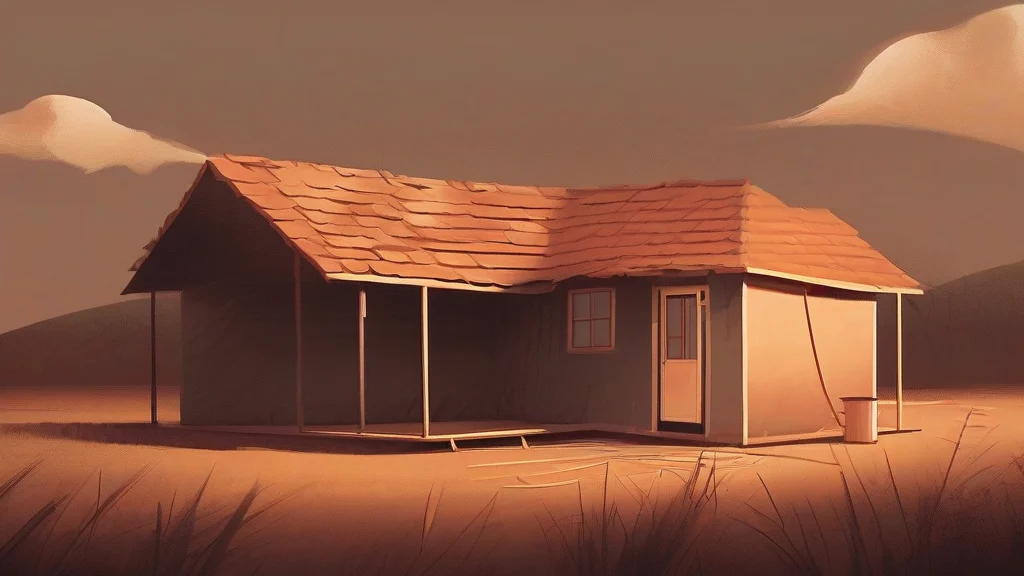
What does unroofed mean?
Unroofed most commonly describes a building or structure that has no roof, leaving its interior exposed to the sky and weather. The word is especially associated with ruins, abandoned buildings, damaged structures, and buildings undergoing restoration. It is formed from the ordinary English word roof with the negative prefix un-, and it can function both as an adjective and as the past tense or past participle of the verb unroof, meaning to remove the roof from a structure. In a description such as “the house stood unroofed,” the emphasis is on the building’s exposed condition, whether that condition results from deliberate demolition, storm damage, decay, or construction. The word is useful when a speaker needs to specify the absence of roofing more directly than “open” or “uncovered” can. It is uncommon in general conversation but common in architectural, historical, and descriptive writing.
Having no roof; especially of a building or structure that is open at the top.
"The partially collapsed warehouse was left unroofed after the fire."
This is the dominant modern use and is often applied to ruins, buildings, and structural remains.
To remove the roof from a building or structure.
"The restoration team unroofed the chapel before repairing its walls."
In this use, unroofed is the past tense and past participle of unroof.
Unroofed captures the moment when a building loses its shelter and becomes an open frame against the sky.
Reviewed by Deb Chak, Editor. AI-assisted content curated by RJS Tech Solutions LLP.
Where does unroofed come from?
Unroofed is an English formation combining the negative prefix un- with the noun roof. The word roof descends from Old English hrof, referring originally to the upper covering of a building. The verb unroof, meaning to take the roof off, developed from the same basic material, while related forms such as roofing and roofer show the broader English word family.
Related word forms
How unroofed is actually used
As an adjective, unroofed is most often used literally of buildings, ruins, and other structures. It can also be used as the past participle of unroof, and the word may describe either the finished state of being without a roof or the action of removing one.