
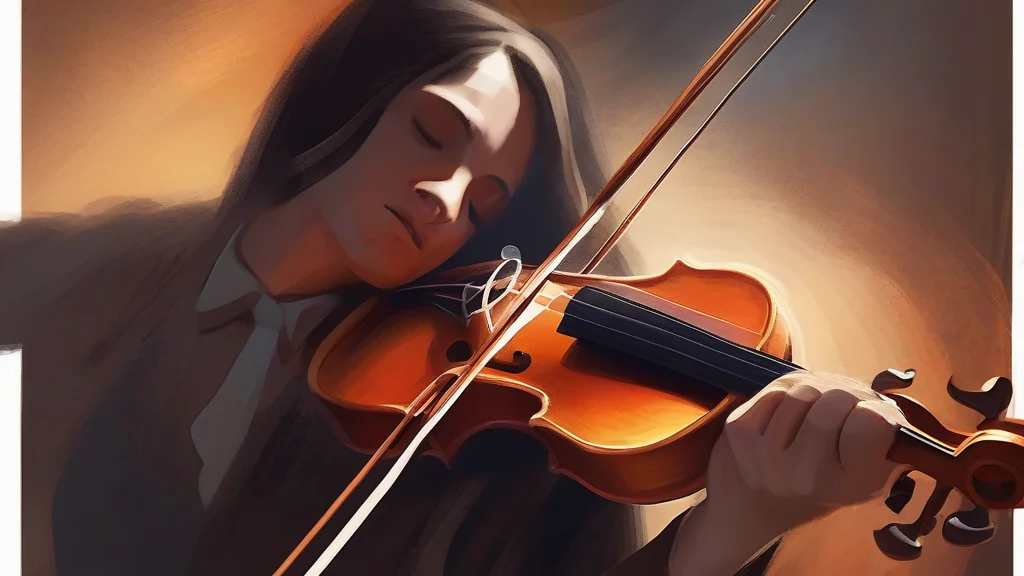
What does violin mean?
A violin is a four-stringed bowed instrument with a hollow wooden body, a neck, and a fingerboard. It is the highest-pitched and smallest member of the violin family, which also includes the viola, cello, and double bass. The instrument is played by drawing a bow across its strings, by plucking them with the fingers, or through related techniques such as pizzicato. In British and American English, “violin” is the standard general term for the instrument, while “fiddle” is especially common in informal references to folk, country, bluegrass, and traditional music. The violin has a prominent role in orchestras, chamber music, string quartets, and solo repertoire, and is also strongly associated with musical instruction and practice. Its clear, carrying tone and expressive vibrato make it a versatile voice across classical and popular styles. The term can also refer more broadly to the instrument family’s violin section or to a player when used in phrases such as “the world’s finest violin.”
nounA violin is a bowed string instrument with a hollow wooden body, a neck, and four strings, typically tuned in perfect fifths. It is the smallest member of the violin family and is played with a bow or, in some musical styles, by pizzicato.
- A four-stringed bowed musical instrument belonging to the violin family, held under the chin and played with a bow or plucked with the fingers.
"She practised her scales on the violin before the orchestra rehearsal."
"The violinist's bow seemed to hover above the strings before the final note."
"He wrote a violin concerto that combines traditional orchestral forms with folk melodies."
The standard plural of violin is violins.
"The shop sells violins, bows, cases, and other accessories."
The violin’s name comes from the Italian diminutive violino, literally a “small viola,” yet it became the most prominent voice in the string family.
Reviewed by Deb Chak, Editor. AI-assisted content curated by RJS Tech Solutions LLP.
Where does violin come from?
The word entered English in the early 17th century from Italian violino, a diminutive of viola meaning “small viola.” The Italian forms ultimately derive from Medieval Latin vitula, an ancient term associated with a stringed instrument. English violin belongs to the same etymological family as viola, viol, and violone, all of which developed from related forms of that Latin word.
Related word forms
How violin is actually used
The word is formal and neutral. In informal contexts, especially folk, bluegrass, and country music, a violin may be called a fiddle, though the two terms can refer to the same instrument in different performance traditions.
Easily confused with violin
A violin is generally smaller and has four strings, while a viola is slightly larger, has a deeper register, and is tuned a fifth lower.