
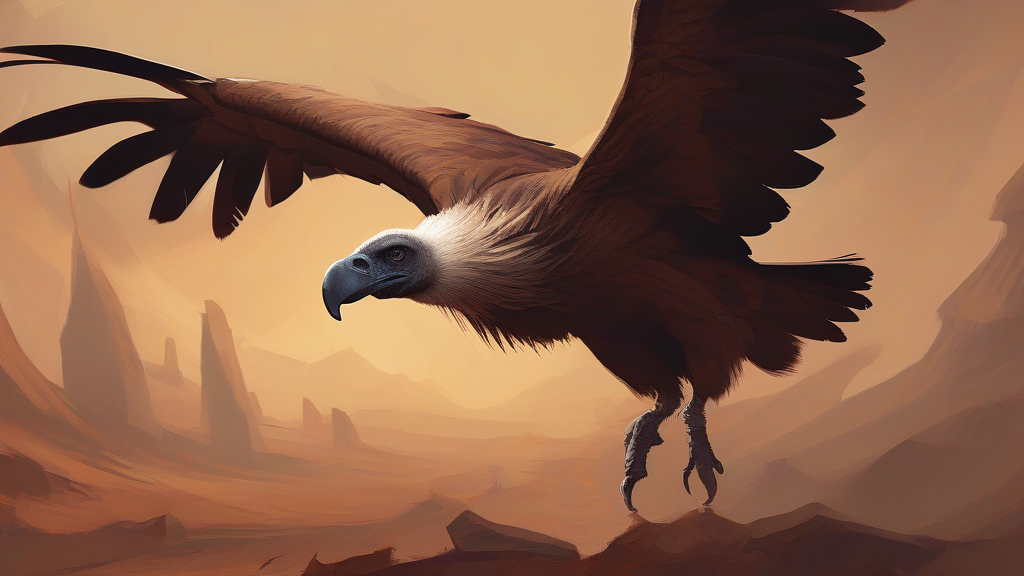
What does vulturine mean?
Vulturine is an adjective meaning “of or like a vulture.” In literal zoological contexts, it describes birds whose appearance evokes a vulture, as in the names vulturine eagle and vulturine guineafowl. More often, writers use it figuratively for a person, expression, or arrangement that seems predatory, scavenging, or opportunistically exploitative. A vulturine stare therefore suggests not merely a fierce look but watchfulness and a readiness to feed on weakness. The word is uncommon but precise, and it carries a strongly negative, often literary tone. Unlike vulture, which names a particular kind of bird and can also serve as a metaphor, vulturine is essentially an adjective: it characterizes resemblance or behavior without independently naming the bird. Its unusual sound and vivid image make it useful when the intended sense is specifically vulture-like rather than simply ravenous, cruel, or unkind.
adjectiveOf, resembling, or characteristic of a vulture, especially in appearance or in a predatory, scavenging, or opportunistically exploitative manner.
- Resembling or characteristic of a vulture, especially in a predatory, scavenging, or opportunistically exploitative manner.
"He regarded the committee with a vulturine eye, sensing weakness in the proposal."
"The editor watched the struggling newspaper with a vulturine interest in its financial problems."
"The novel's vulturine antagonist manipulates the corrupt politicians around him."
A vulturine stare belongs to the bird that sees every weakness in the flock.
Reviewed by Deb Chak, Editor. AI-assisted content curated by RJS Tech Solutions LLP.
Etymology of vulturine
Vulturine comes through Latin from vulturinus, meaning “vulture-like” or “of a vulture,” which was formed from vultur, the Latin word for a vulture. English retained this derived sense and extended it figuratively to describe people, expressions, and behavior. Its close relatives include the common noun vulture and the rarer adjective vulturous.
How vulturine is actually used
Chiefly literary, figurative, or zoological. In figurative use the term is strongly derogatory and suggests predatory opportunism rather than merely hunger or aggressiveness.
Easily confused with vulturine
A vulture is the bird itself, whereas vulturine is an adjective describing something that resembles a vulture or acts in a vulture-like way.