
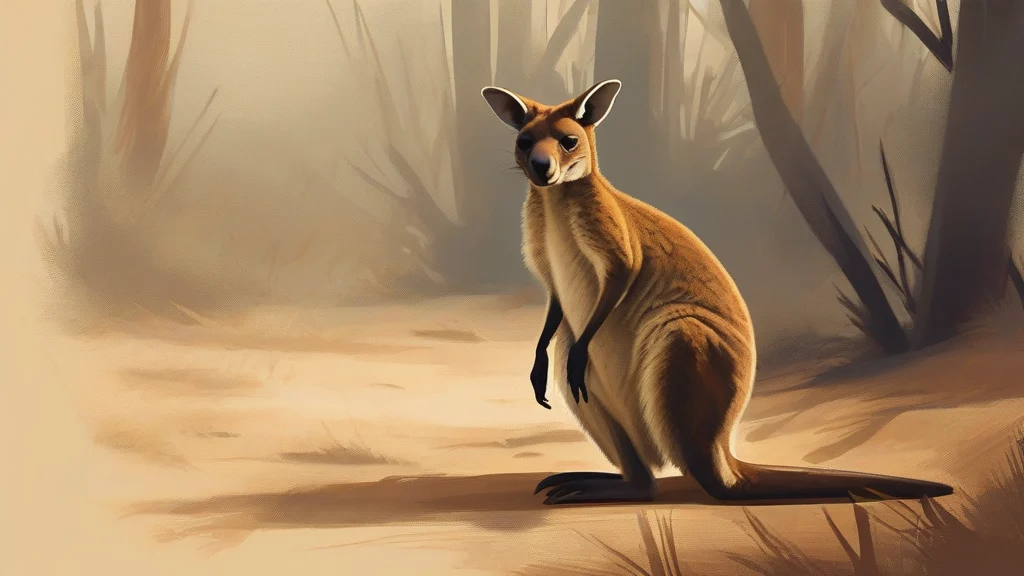
What does wallaby mean?
A wallaby is a kangaroo-family marsupial native to Australia and nearby islands. The name covers many relatively small species, although the distinction from a kangaroo is not a strict scientific division and varies in everyday speech. Wallabies have strong hind legs, long tails, and pouch-bearing females whose young are called joeys. The word also appears in Australian expressions such as “on the wallaby,” meaning on a journey through the bush. Its etymology is especially notable: English borrowed it from the Dharug language of the Sydney region during the early nineteenth century. Today it is common in wildlife reporting, travel writing, and Australian vernacular. For many speakers, wallaby is the more immediately evocative term for a small or medium-sized kangaroo-like animal, while “kangaroo” is usually reserved for the larger, more familiar species.
nounAny of various kangaroo-family marsupials native to Australia and nearby islands, generally smaller than animals commonly called kangaroos. In Australian English, the word can also refer to a journey or walk in the bush.
- Any of various marsupials of the kangaroo family, especially the smaller species native to Australia and nearby islands.
- In Australian English, an excursion or journey on foot through the bush.
"A wallaby bounded across the grassland with its powerful hind legs and long tail balancing its body."
"The guide spotted a wallaby resting among the ferns near the edge of the track."
"We went on the wallaby for a week, camping beside the river and walking through the hills."
The regular plural is wallabies, pronounced /ˈwɒləbiz/ in British English and /ˈwɑːləbiz/ in US English.
"A group of wallabies grazed beside the road."
The word entered English from the Dharug people of the Sydney region, giving this familiar Australian marsupial a distinctly Indigenous name.
Reviewed by Deb Chak, Editor. AI-assisted content curated by RJS Tech Solutions LLP.
Where does wallaby come from?
The word entered English in the early nineteenth century from the Dharug Aboriginal language of the Sydney region. Its source form was walabi, the Dharug name for a species of kangaroo. The modern spelling wallaby reflects the development of English orthography after the word was borrowed.
Related word forms
How wallaby is actually used
In everyday English, wallaby is familiar and untechnical, although the boundary between wallabies and kangaroos is largely conventional rather than sharply taxonomic. The expression “on the wallaby” is characteristic Australian usage and may sound distinctly regional to speakers in Britain and the United States.
Easily confused with wallaby
Both are macropods, but wallaby generally names the smaller members of the group, whereas kangaroo usually refers to the larger species.