
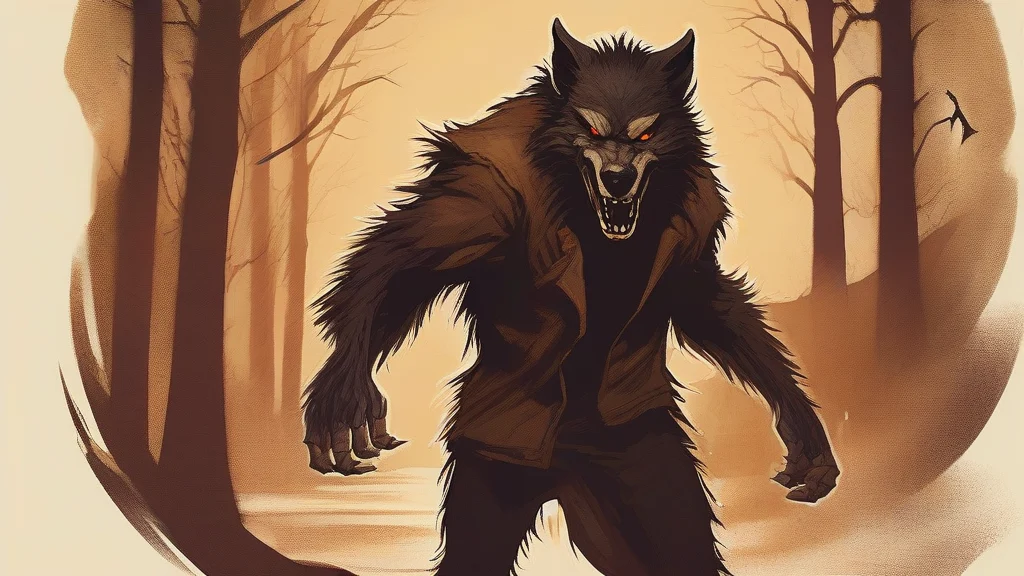
What does werewolf mean?
A werewolf is a human being in folklore or fiction who transforms into a wolf or is portrayed as a human-wolf hybrid. The word comes from an old compound meaning a man or human creature made wolf-like, and it is closely associated with European legends about people who become wolves under certain circumstances, especially at night. In contemporary usage, werewolves are common subjects of horror stories, films, games, and other fantasy works. The term can also be used figuratively to describe someone as ferocious, predatory, or seemingly untamed, although this usage often carries dramatic or humorous implications. Werewolf is a useful word because it links a real animal with a long-standing human fear of hidden danger and the boundary between human and animal nature. Its modern associations are strongly shaped by horror and popular culture, even though the underlying legend is much older.
nounA fictional or mythological human being who transforms into a wolf, or who is otherwise portrayed as having wolf-like characteristics. In modern usage, the word is most often associated with folklore, horror, and fantasy.
- A mythical or fictional human being who transforms into a wolf.
- A person portrayed in folklore as having wolf-like traits, predatory instincts, or an animal nature.
"The village had always avoided hunting the old forest, where legends claimed that a werewolf roamed after dark."
"A werewolf emerged from the forest and vanished into the storm."
"The critic described the film's director as a werewolf, suggesting a fierce and uncontrollable creative temperament."
The standard plural is werewolves, with the internal -e- retained.
"A pack of werewolves hunted the outskirts of the town."
The werewolf combines the ordinary fear of the dark with the ancient suspicion that the wilderness might conceal a human predator among us.
Reviewed by Deb Chak, Editor. AI-assisted content curated by RJS Tech Solutions LLP.
Where does werewolf come from?
The English word was formed from an Old English or Middle English compound whose first element meant a man or human creature and whose second element meant wolf. Older forms include werwulf, while the modern spelling werewolf became established as the familiar form. The elements ultimately belong to the Germanic family of words for wolf-related creatures and human beings, and the word's history reflects older European traditions of human-wolf transformation.
How werewolf is actually used
Werewolf is primarily a word of folklore, fantasy, and horror. It is usually figurative when used outside those contexts, and it can carry connotations of danger, savagery, secrecy, or untamed instinct. The related term lycanthrope is more formal and broader, while wolf-man is often used for a specific fictional character or type.
Easily confused with werewolf
A lycanthrope is a person believed or depicted to transform into an animal, often a wolf, while werewolf more specifically refers to a human-wolf creature and is the conventional term in modern folklore and fiction.
Werewolf is the standard English word for a human being associated with wolf-like transformation or appearance.