
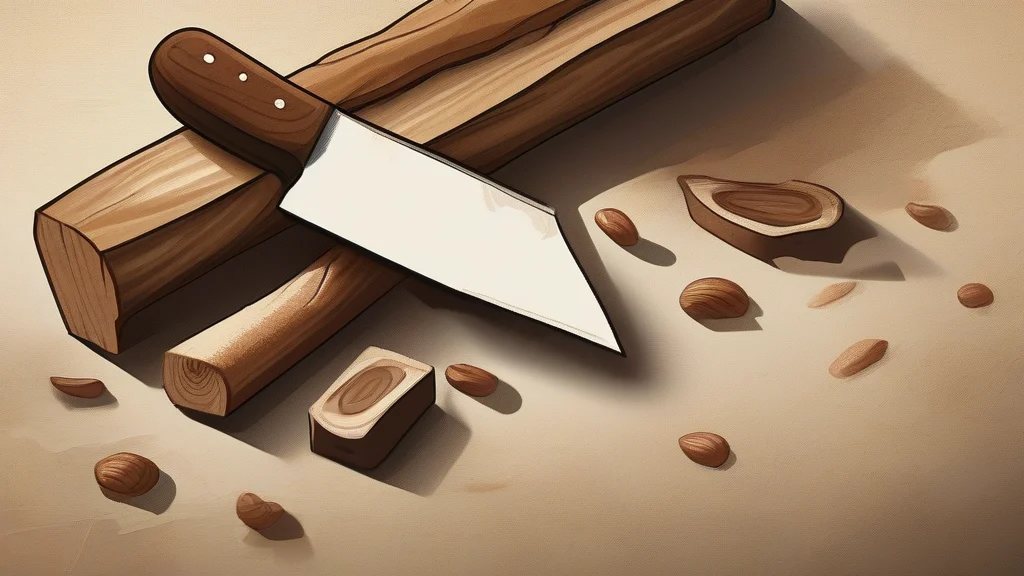
What does whittled mean?
Whittled is the past tense and past participle of whittle. In its literal sense, it describes cutting, shaving, or shaping material with a knife, usually as small pieces are removed; a craftsman might whittle a branch into a flute or a piece of wood into an animal figure. Figuratively, whittled means reduced gradually in quantity, size, scope, or resources. In this use, the word often suggests a series of small reductions rather than a single decisive removal, as when a committee whittles a proposal down to its essential points or an organization gradually loses staff. The verb can therefore describe both physical craftsmanship and the careful erosion of something elaborate. It is especially associated with wood, but the literal verb can apply to other workable materials. The phrase “whittled down” is particularly common, while “whittled-away” forms may describe something gradually depleted. Although the word evokes patience and incremental change, its figurative use can carry a mildly negative implication that valuable substance is being removed.
To cut, shave, or shape material with a knife; to reduce something gradually in size, amount, scope, or resources.
"The negotiators spent two hours whittling the agreement into an acceptable form."
Whittled is the past tense and past participle of whittle. Its figurative use typically implies repeated or incremental reduction.
Shaped or reduced by removing small pieces; reduced in size, scope, or elaborateness.
"The committee approved a whittled-down version of the proposal."
This is chiefly a participial adjective, especially common in the expression “whittled-down.”
A knife can turn a branch into a flute; figuratively, it can turn a grand plan into a spare one.
Reviewed by Deb Chak, Editor. AI-assisted content curated by RJS Tech Solutions LLP.
Where does whittled come from?
The word developed from Middle English whittle, a noun denoting a small knife or cutting tool, and the verb's original cutting sense developed from that tool. The later figurative meaning, describing gradual reduction, is an extension of the idea of removing small pieces. The Middle English form ultimately belongs to an Old English family of words associated with smallness.
Related word forms
How whittled is actually used
The literal sense is neutral and traditionally associated with wood. The figurative sense suggests gradual reduction, often implying that something is being pared back or allowed to erode.