
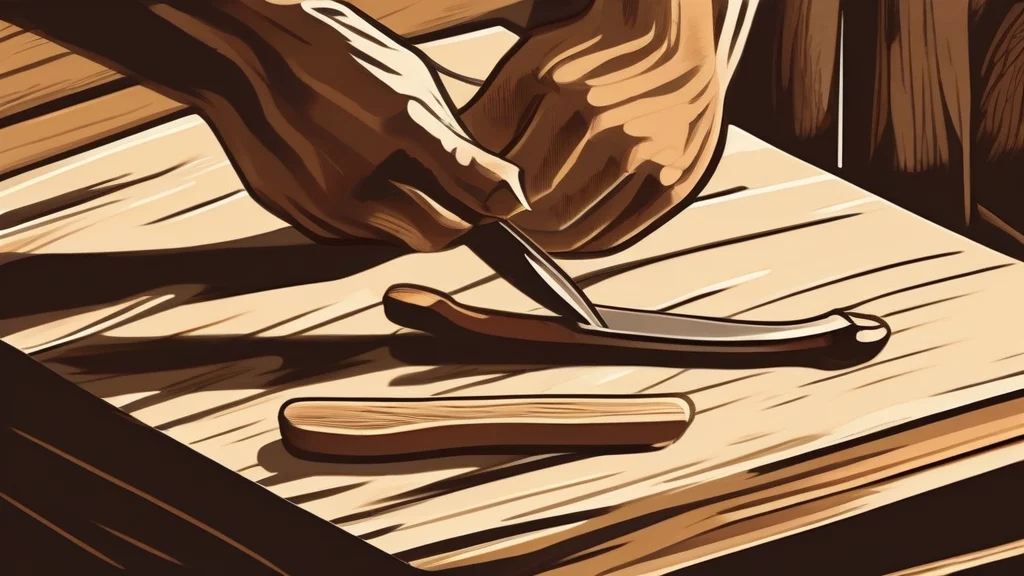
What does whittling mean?
Whittling is the practice of cutting or shaping wood with a knife by shaving away small pieces. The activity is associated with patience, craftsmanship, and often the making of simple objects from natural materials such as sticks or blocks of wood. In figurative expressions, whittling means reducing or diminishing something gradually, often through a series of small adjustments: a negotiator may whittle away at a disputed clause, or a committee may whittle down a proposal. The word can therefore describe both a hands-on craft and the slow erosion or refinement of an abstract situation. Compared with the broader term “carving,” whittling more specifically suggests the removal of small pieces with a knife. Its continuing usefulness as a verb comes from this vivid image of sustained, incremental change: even a modest process can transform a piece of wood or steadily alter a difficult matter.
To cut or shape wood with a knife by removing small pieces; figuratively, to reduce or diminish something gradually.
"He whittled the branch into a narrow walking stick."
The literal sense normally takes wood as its object. Figurative use commonly appears with “away” or “down” and implies gradual reduction through repeated small steps.
The activity or process of cutting or shaping wood with a knife.
"Whittling can be a quiet and absorbing pastime."
The activity itself is normally uncountable. The countable plural is rare and is used mainly for small pieces or objects produced by whittling.
"He swept the wood whittlings off the table."
Whittling is carving in miniature: a knife, a piece of wood, and the patience to let every shaving fall exactly where it should.
Reviewed by Deb Chak, Editor. AI-assisted content curated by RJS Tech Solutions LLP.
Where does whittling come from?
Whittling belongs to the English word family of “whittle,” which was in use by the late 16th century for cutting or shaping material with a small knife. The family also developed figurative senses involving gradual reduction. The precise origin of “whittle” is not securely established, and proposed links to particular Germanic roots remain disputed, so the safest historical account is that the noun and verb developed together around the established idea of a small knife or the act of cutting with one.
Related word forms
How whittling is actually used
Whittling is neutral in register, though it often conveys patience, simplicity, or rustic informality. In figurative use, the image of removing small pieces gradually makes it especially suitable for describing the incremental reduction of time, resources, problems, or arguments. It is more specific than the broad word “carving” because it typically involves a knife and relatively small shavings.
Easily confused with whittling
Whittling means cutting or shaping wood with a knife, whereas whistling means producing a high-pitched musical sound with the lips or through an instrument.