
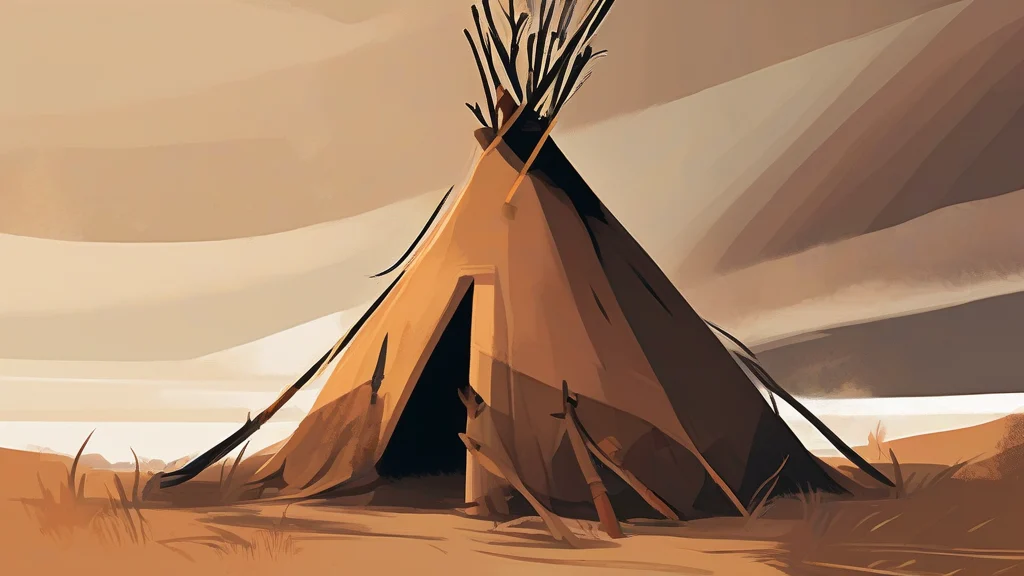
What does wickiup mean?
Wickiup is a North American noun for a small shelter or hut traditionally constructed from readily available natural materials, such as prairie grasses, brush, branches, or hides. It is especially associated with the Indigenous peoples of the Great Plains and can refer either to a specific type of shelter or, more broadly, to a modest temporary dwelling. In literature, museum labels, ethnographies, and accounts of frontier life, the word identifies a practical structure shaped by its environment and available resources. Today it is encountered less often in ordinary speech than terms such as hut or shelter, but it remains valuable because it preserves both a distinct cultural context and a Dakota linguistic source. The spelling wickiup became established in English, while variants such as wickyup and wickup also occur in older usage. Its associations are primarily regional and historical rather than universal across the English-speaking world.
nounA small shelter or hut traditionally made from grass, brush, hides, or other available materials, especially by Indigenous peoples of the Great Plains. The word is also used more broadly for a simple or temporary dwelling.
- A small shelter or hut made from grass, brush, hides, or similar materials.
- A simple, temporary dwelling or shelter.
"The museum's guide described the wickiup as a temporary shelter built from prairie grasses."
"An illustration in the ethnography shows a family beside a wickiup near the Plains."
"The guide described how the shelter had been constructed as a wickiup from bent branches and grasses."
The regular plural adds -s.
"The site contains reconstructed wickiups and other dwellings."
The word carries a Dakota voice into English: it comes from Dakota wicípi, meaning “lodge.”
Reviewed by Deb Chak, Editor. AI-assisted content curated by RJS Tech Solutions LLP.
Where does wickiup come from?
The English word entered use in the late nineteenth century as a borrowing from Dakota wicípi, meaning “lodge” or “dwelling.” Early English forms included spellings such as wickyup and wickup, with wickiup eventually becoming the standard spelling.
How wickiup is actually used
Most common in North American English, particularly in descriptions of Plains cultures, museum exhibitions, and historical frontier life. In present-day writing it often has a historical, cultural, or ethnographic register.
Easily confused with wickiup
A wickiup is generally a small shelter made from grass, brush, or hides, whereas a wigwam is a domed frame-and-cover dwelling, especially one associated with Algonquian peoples.