
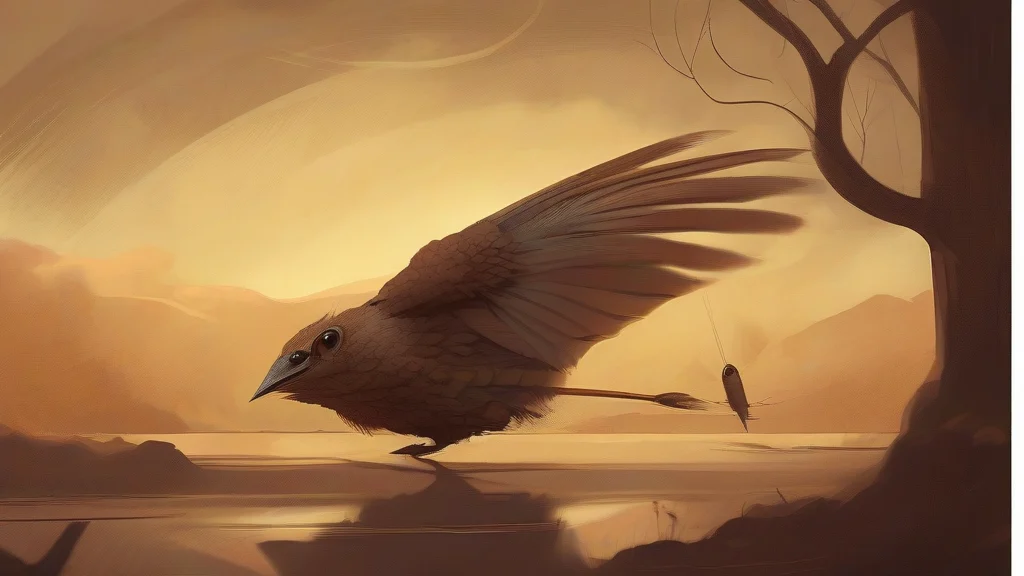
What does wingless mean?
Wingless is an adjective meaning “without wings.” It is used for organisms, body parts, vehicles, and designed objects whose defining feature is the absence of wings. The term can describe a naturally wingless creature, such as a flea, or an organism whose wings are absent, reduced, or nonfunctional. In biology, it is especially useful for distinguishing wingless forms from winged relatives and for describing evolutionary changes that suppress wing development. Outside science, “wingless” is also vivid and accessible, especially in descriptions of aircraft, mythical creatures, and imagined designs. The expression is neutral rather than emotional, although it may suggest awkwardness or limitation when applied to an animal intended to fly. Because the word plainly combines “wing” with “-less,” it is immediately understandable while remaining more specific than the broader “flightless.”
adjectiveHaving no wings; lacking wings or winglike structures.
- Having no wings or winglike structures.
"The newly emerged insects were tiny and wingless, hiding beneath the leaves."
"Researchers discovered a rare wingless form of the beetle in the forest canopy."
"The design team imagined a wingless aircraft capable of moving rapidly through narrow tunnels."
One of nature’s most effective jumpers never had wings: fleas are wingless insects built for sudden, spring-loaded leaps.
Reviewed by Deb Chak, Editor. AI-assisted content curated by RJS Tech Solutions LLP.
Where does wingless come from?
English “wingless” is a compound formed from “wing” and the suffix “-less.” The noun “wing” descends from Old English winge, while “-less” comes through Middle English from Old English -lēas, meaning “without” or “lacking.” The compound appears in English in the 19th century, alongside related forms such as “winged” and “winger,” which preserve the older sense of a wing or a wing-bearing creature.
Related word forms
How wingless is actually used
Neutral and descriptive. It is common in biology and natural history, especially when referring to organisms, anatomical structures, mutants, and developmental forms. It can also be used figuratively or in descriptions of vehicles and machines.