
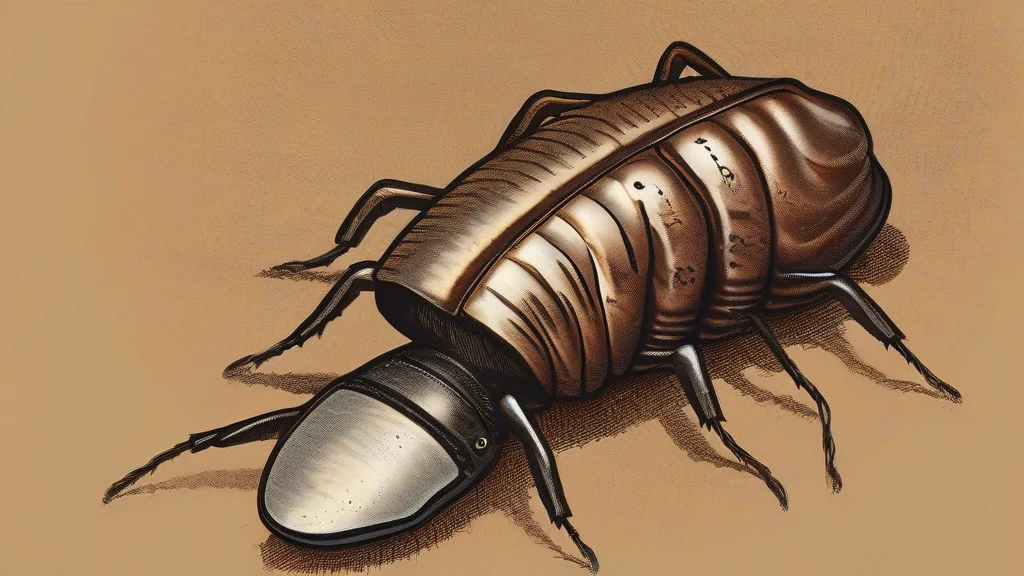
What does wireworm mean?
Wireworm is the common name for the slender, hard-bodied larva of a click beetle, a beetle in the family Elateridae. These larvae live in soil and feed on roots and underground plant parts, so a heavy population can damage cereals, potatoes, vegetables, and other crops. Gardeners and farmers may encounter them while digging or when plants wilt despite adequate moisture. The term is especially useful in agricultural and pest-control discussions, where expressions such as "wireworm damage" and "wireworm control" refer to the problem rather than to a particular species. Although an individual larva is a wireworm, the plural wireworms is often used for an infestation. Wireworm should not be confused with an earthworm: the former is a beetle larva with a segmented, relatively hard body, while an earthworm is a true worm belonging to the annelid group. The compound name combines the elements "wire" and "worm," reflecting the larva's thin, wiry appearance.
nounA slender, hard-bodied, wormlike larva of a click beetle (family Elateridae), usually living in soil and feeding on roots and other underground plant parts. Wireworms are agricultural pests, especially of potatoes, cereals, and vegetables.
- The larva of a click beetle, characterized by its slender, segmented, hard body; when numerous in soil, wireworms damage crop roots and underground plant parts.
"A severe wireworm infestation left several rows of potatoes stunted and unproductive."
"A severe wireworm infestation left several rows of potatoes stunted and unproductive."
"The farmer found a wireworm near the damaged roots and recognized it as a click-beetle larva."
The standard plural is wireworms, as in a plural noun or when referring collectively to the larvae that infest a crop.
"Wireworms damaged the roots of the newly planted potatoes."
A wireworm is not an earthworm at all—it is a click beetle's larva, and a hungry population can devastate a potato field.
Reviewed by Deb Chak, Editor. AI-assisted content curated by RJS Tech Solutions LLP.
Etymology of wireworm
Wireworm is an English compound formed from "wire" and "worm." "Worm" continues Old English wyrm, inherited from Proto-Germanic, while "wire" came through Old English from Latin vīra; the compound refers to the larva's slender, wiry-looking body.
How wireworm is actually used
This is a technical term used in agriculture, horticulture, and pest control. It commonly refers collectively to the larvae of several click-beetle species rather than to a single species.
Easily confused with wireworm
A wireworm is the hard-bodied larva of a click beetle, whereas an earthworm is a true worm belonging to the annelid group.