
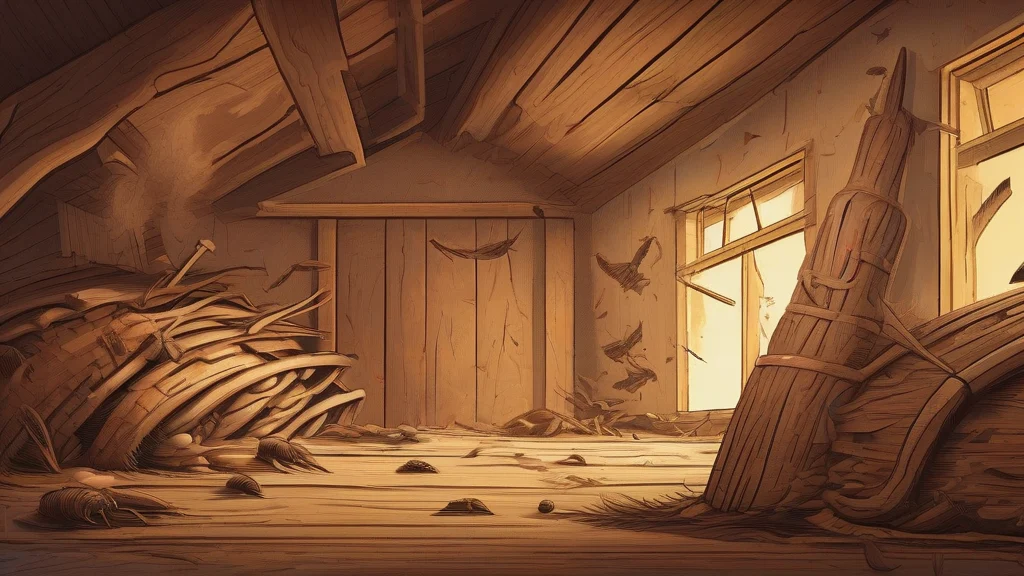
What does woodworm mean?
The word “woodworm” ordinarily denotes the larval stage of a beetle that bores into wood, particularly the small beetles responsible for damage to furniture, floors, and older buildings. Such larvae may leave networks of holes and fine powder, commonly called frass, behind as they feed. The term can be used more broadly for any insect larva that bores into timber. In informal British English, “woodworm” also serves as a dismissive nickname for a dull or uninteresting person, though this figurative use can sound old-fashioned elsewhere. Woodworms are therefore both a practical concern for people caring for wooden objects and a vivid example of how an agricultural and household word can acquire a figurative social meaning. For precision, a woodworm should be distinguished from a shipworm: the former is normally an insect larva, while the latter is a marine bivalve.
nounA larva of a wood-boring beetle, especially a furniture beetle, or more generally any wood-boring insect larva. Informally and chiefly in British English, it can also mean a dull or uninteresting person.
- The larva of a wood-boring beetle, especially a furniture beetle, or any other insect larva that bores into wood.
- Informally, a dull or uninteresting person.
"The old chest was opened to reveal woodworm damage and a scattering of fine powder."
"The antique desk was found to be full of woodworm holes."
"Calling him a woodworm was an unusually blunt way of saying that nobody wanted to listen to him."
The standard plural is “woodworms,” particularly when referring to multiple larvae or an infestation.
"The old floorboards were riddled with woodworms."
A woodworm may be tiny, but an infestation can turn a treasured chest into a sawdust factory.
Reviewed by Deb Chak, Editor. AI-assisted content curated by RJS Tech Solutions LLP.
Etymology of woodworm
“Woodworm” is a transparent English compound formed from “wood” and “worm.” Its components are inherited words: “wood” descends from Old English wudu, while “worm” comes from Old English wyrm, an Old English term for a worm or other elongated creature. The compound refers to a creature that lives in and bores through wood.
Related word forms
How woodworm is actually used
In precise or technical contexts, “wood-boring beetle larva” is often clearer. The figurative sense is informal, somewhat disparaging, and especially associated with British English.
Easily confused with woodworm
A woodworm is usually the larval stage of a terrestrial wood-boring beetle, whereas a shipworm is a marine bivalve mollusk that bores into submerged wood.