
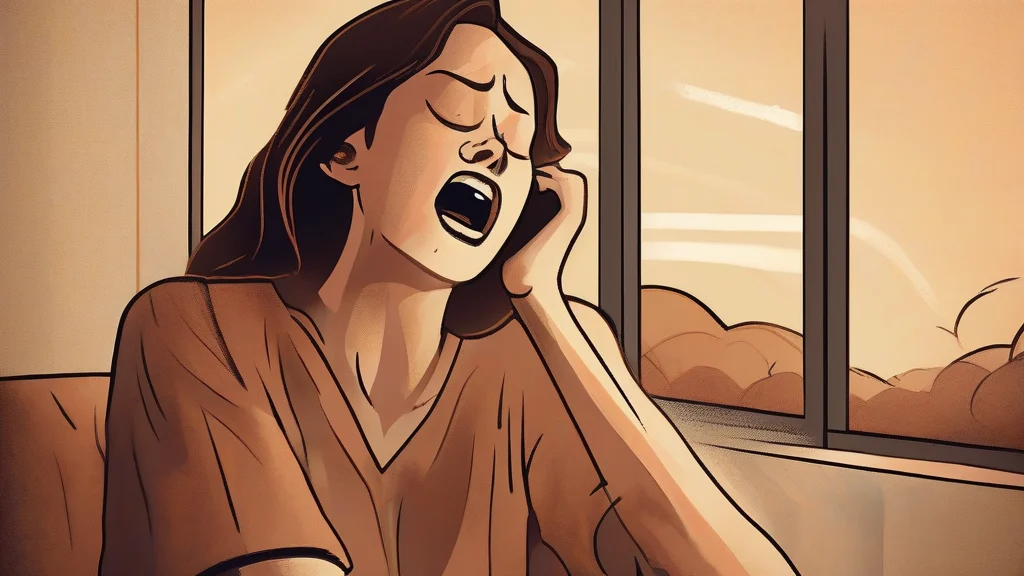
What does yawn mean?
Yawn is the familiar word for opening the mouth wide, usually while drawing in a deep breath in response to tiredness, boredom, or drowsiness. As a verb, it describes this largely involuntary action, although people can also yawn deliberately or metaphorically to describe something opening into a great gap. As a noun, a yawn is an instance of that action; more rarely, it denotes a broad space or chasm. The related form 'yawning' is especially common in fixed expressions such as 'a yawning gap,' where it means dangerously or conspicuously wide. Yawning is also well known as a contagious behaviour: observing, hearing, or even reading about a yawn may prompt one nearby. The word is consequently both an ordinary description of a common human reaction and a useful literary metaphor for emptiness, danger, distance, or disparity. In everyday speech, it remains informal and generally carries no strongly negative connotation beyond suggesting tiredness or boredom.
To open the mouth wide and take a deep breath, usually involuntarily when tired, bored, or drowsy; figuratively, to open or become wide.
"The passengers began to yawn during the delayed journey."
The literal use is normally intransitive. In figurative use, a place, gap, or danger may 'yawn' before someone or something.
An act or instance of opening the mouth wide and taking a deep breath; more rarely, a large or wide gap.
"A yawn spread through the children seated near the front."
The noun takes the plural 'yawns' when referring to separate instances of yawning.
The plural refers to separate instances of yawning.
"The professor suppressed several yawns during the lengthy discussion."
A yawn is famously contagious: seeing or hearing someone yawn can make you yawn too.
Reviewed by Deb Chak, Editor. AI-assisted content curated by RJS Tech Solutions LLP.
Where does yawn come from?
The word comes from Old English gianian, meaning 'to yawn,' and appeared in Middle English as yane. It belongs to a Germanic family of words for yawning that included Old Norse gina, Old High German ginen, and Middle Dutch ginen. The modern hard g- reflects usage that developed in northern English, while the standard pronunciation retained a long vowel sound.
Related word forms
How yawn is actually used
The literal verb is normally intransitive, and the noun is countable when it refers to an individual act of yawning. The form 'yawning' is commonly used attributively in expressions such as 'a yawning gap.' There is no substantial British–US difference in ordinary usage.
Easily confused with yawn
A yawn is usually involuntary and often signals tiredness or boredom, whereas gaping can be deliberate and primarily means opening the mouth or another opening very wide.