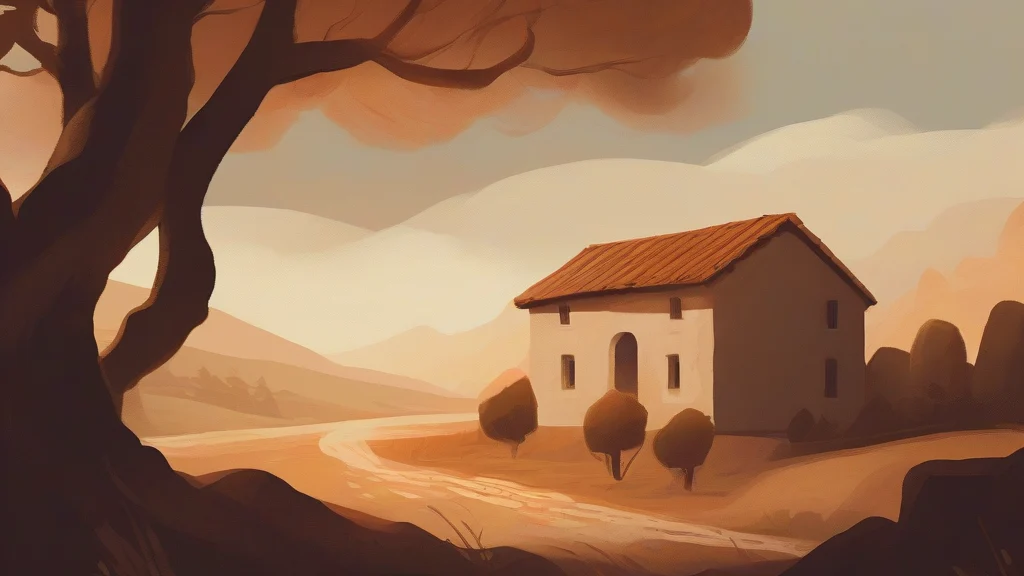
What does arcadian mean?
Arcadian describes anything suggestive of Arcadia, a rugged region of ancient Greece that classical poets reimagined as a paradise of shepherds, unspoiled meadows, and carefree contentment. Over centuries, the term came to stand for an idealized vision of rural life — simple, serene, and untouched by urban bustle. In modern usage it appears most often in literary, artistic, and landscape contexts: a painting might depict an arcadian scene, a garden might be praised for its arcadian charm, or a writer might long for an arcadian escape from city pressures. Because it names an imaginative ideal rather than actual countryside, the word often carries a nostalgic, even utopian tone, and critics sometimes use it to describe pastoral traditions in literature from Virgil onward. It can also function as a noun, referring to an inhabitant of Arcadia itself. Elegant and evocative, arcadian remains a useful shorthand for humanity's enduring dream of a simpler, more harmonious life close to nature.
Characteristic of or evoking Arcadia and its literary image as a land of simple, idyllic rural happiness.
"The novel opens with an arcadian vision of orchards and grazing flocks."
Frequently used in literary criticism and descriptions of landscape art.
An inhabitant of Arcadia, the region of ancient Greece.
"In Virgil's poems, the Arcadians lead lives of song and leisure among the hills."
Usually capitalized as 'Arcadian' in this sense.
Applies only to the noun sense meaning an inhabitant of Arcadia; the adjective has no plural form.
"The poem imagines the Arcadians dancing at dusk beneath the oaks."
The word comes from a real region of mountainous Greece that poets transformed into the most famous imaginary paradise in Western literature.
Reviewed by Deb Chak, Editor. AI-assisted content curated by RJS Tech Solutions LLP.
Etymology of arcadian
The word derives from Arcadia, a mountainous region in the central Peloponnese of Greece whose name traces back to ancient Greek. Although the historical Arcadia was hardly an easy paradise, poets of antiquity — notably Theocritus and later Virgil in his Eclogues — made it the emblematic setting of pastoral poetry, and Renaissance writers carried this idealized image into European literature. English adopted the adjective by the early seventeenth century, alongside the noun form for the region's inhabitants. The related term Acadian arose separately when French explorers named their North American colony after this same imagined Arcadia.
Related word forms
How arcadian is actually used
Literary and somewhat elevated in register; common in poetry, art criticism, and landscape writing. Often carries a wistful or nostalgic connotation, since arcadian settings are imagined ideals rather than realistic descriptions of country life.
Easily confused with arcadian
Acadian refers to the French-speaking people and culture of Acadia in maritime Canada, whereas arcadian refers to the idealized pastoral world associated with ancient Greece's Arcadia.