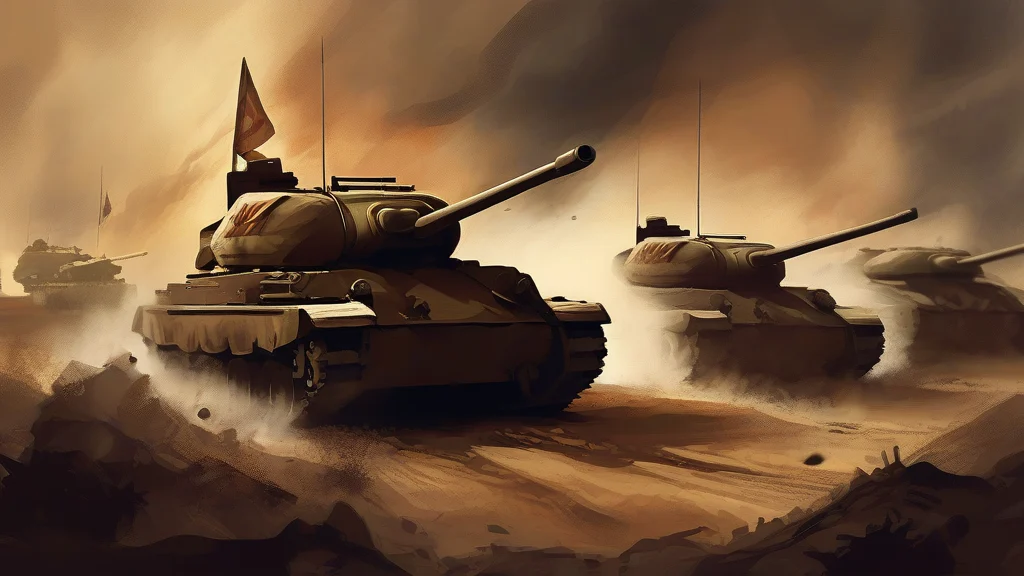
What does blitzkrieg mean?
Blitzkrieg is a noun borrowed from German meaning 'lightning war': a sudden, violent military offensive designed to win a rapid victory by combining fast-moving tanks, motorized infantry, and air power to punch through enemy defences before they can organise a response. The term became famous during the Second World War, particularly describing Germany's campaigns in Poland (1939) and Western Europe (1940), though historians debate how formally the Wehrmacht itself used it as a doctrine. Beyond its military origin, blitzkrieg has entered everyday English as a vivid metaphor for any swift, overwhelming campaign — a company's product launch, a politician's media push, or a sports team's early scoring spree. Because of its wartime associations, the word retains an aggressive, high-intensity connotation; it implies shock, speed, and decisiveness rather than attrition. Its plural is blitzkriegs, and it is closely related to the shorter English word 'blitz', which now also means an intense burst of activity.
nounAn intense, sudden military offensive intended to achieve a quick victory, typically involving a rapid concentration of tanks, aircraft, and motorized infantry. By extension, any swift, overwhelming attack or campaign in a non-military context.
- A swift, overwhelming military offensive using concentrated armour and air power to break through enemy lines quickly.
- A fast, intense, or sustained campaign or effort in a non-military sphere (e.g. business, politics, advertising).
"The general's blitzkrieg through the Low Countries caught the Allied forces completely unprepared in 1940."
"Germany's blitzkrieg across Poland in September 1939 marked the beginning of the Second World War in Europe."
"The startup launched a marketing blitzkrieg, flooding every social platform with ads within a single week."
The standard English plural adds -s; no alternative plural is in common use.
"Military historians have analysed several successful blitzkriegs from the early 1940s."
The word that named Hitler's fastest weapon — 'lightning war' — was borrowed into English before the Second World War had even begun.
Reviewed by Deb Chak, Editor. AI-assisted content curated by RJS Tech Solutions LLP.
Etymology of blitzkrieg
Blitzkrieg comes directly from German, where it is a compound of Blitz ('lightning') and Krieg ('war'), literally 'lightning war'. The term was adopted into English around the outbreak of the Second World War in 1939, as journalists described Germany's fast armoured advances. The element Blitz alone was soon borrowed separately into English, giving rise to words like 'the Blitz' for the bombing of British cities and the verb 'to blitz' meaning to attack or overwhelm. Cognates within English include these Blitz-derived forms rather than words from other language families, since both parts of the compound come from common Germanic roots shared with native English words such as 'bright' (related to 'blitz') and 'wary'/'war' (related to 'Krieg').
Related word forms
How blitzkrieg is actually used
The word carries strong historical connotations of the German campaigns of 1939–41 and can therefore sound aggressive or even sinister when applied metaphorically. It is usually used attributively or with an indefinite article ('a blitzkrieg'), and the anglicised plural 'blitzkriegs' is standard. In figurative use it suggests speed and intensity rather than prolonged struggle.
Easily confused with blitzkrieg
'Blitz' is the shortened English form of 'blitzkrieg', but it also refers specifically to the German bombing campaign against Britain (1940–41), while 'blitzkrieg' denotes the broader tactic of rapid combined-arms warfare.