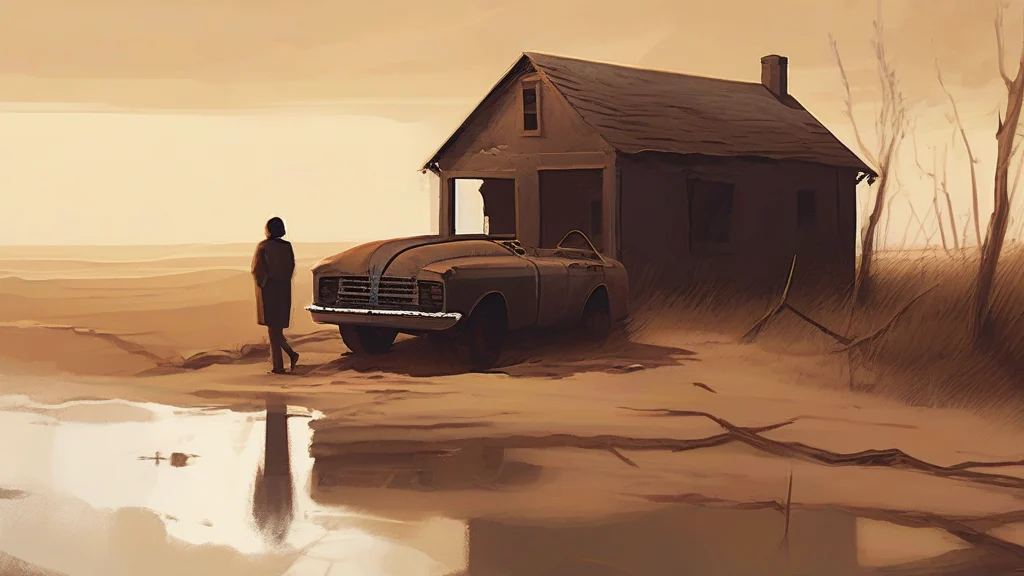
What does abandoned mean?
Abandoned is an adjective describing something that has been left behind and given up: a building no longer inhabited, a vehicle discarded on a roadside, or a child left without care. It derives from the verb 'to abandon', whose roots lie in medieval legal language — the Old French 'a bandon' meant 'under someone's control', so abandoning something originally meant relinquishing one's hold on it. Today the word strongly connotes neglect and desolation, evoking rusting machinery, derelict houses, and forgotten places, which makes it a staple of atmospheric writing about decay and loss. It is standard in both British and American English, appears most often directly before a noun ('an abandoned factory'), and pairs naturally with words like building, vehicle, and mine. Its emotional force extends to people and animals, where it implies not mere disuse but a breach of responsibility.
adjectiveLeft completely without care, support, or occupants; deserted by its owner or by the people responsible for it.
- (of a place or object) deserted and left unused, having been left by its owner or inhabitants
- (of a person, especially a child) left behind and given no further care or support
"The sailors found an abandoned village overgrown with vines."
"They explored the abandoned mine on the edge of town."
"An abandoned puppy was found shivering outside the station."
The word 'abandoned' traces back to an Old French phrase meaning 'under someone's control' — so to be abandoned was originally to be released from someone's command, before it came to mean being left behind entirely.
Reviewed by Deb Chak, Editor. AI-assisted content curated by RJS Tech Solutions LLP.
Etymology of abandoned
Abandoned is the past participle of the verb 'abandon', which entered English from Old French 'abandoner' in the late Middle Ages. The French term came from the phrase 'a bandon', meaning 'at will' or 'under someone's control', rooted in 'ban', a feudal term for a lord's proclamation summoning vassals. Cognates and relatives include 'banish', 'bandit' (originally one outlawed by such a proclamation), and 'contraband'. The adjective sense of being deserted developed alongside the verb's sense of relinquishing possession or responsibility.
Related word forms
How abandoned is actually used
Primarily used attributively before nouns (an abandoned house, an abandoned vehicle), though it also appears predicatively (the car was abandoned). It carries connotations of neglect and loss; describing a person's behaviour as 'abandoned' in the older sense of unrestrained is now rare and literary.
Easily confused with abandoned
Abandonment is the noun meaning the act or state of leaving something behind, while abandoned is the adjective describing the thing that has been left.