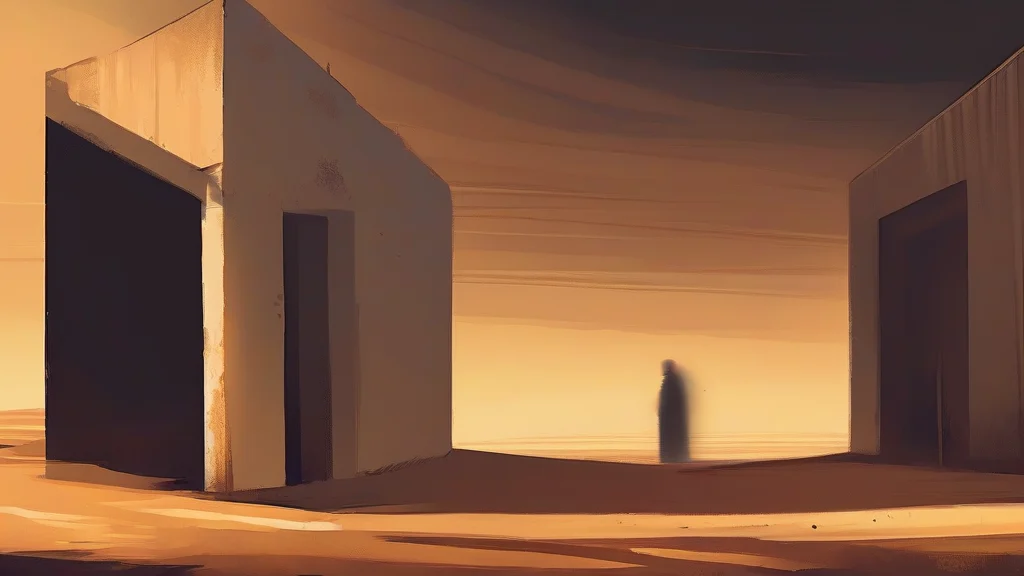
What does deserted mean?
"Deserted" is an adjective used to describe a place that has been emptied of people or left without occupants — a deserted street, village, or island. It can also describe a person who has been forsaken or abandoned, particularly by someone expected to remain loyal. The word derives from the Latin "desertare" (to abandon), via Old French "desert," and shares roots with the English noun "desert," though the two have very different meanings in modern use: one refers to arid land, the other to abandonment. In everyday usage, "deserted" often evokes a mood of desolation, silence, or eeriness, making it a favourite of novelists and travel writers alike. It is common in phrases such as "deserted island," "deserted street," and "deserted building." Because it can be confused with the dessert course of a meal, careful spelling matters — a single "s" separates abandonment from cake.
Empty of people; abandoned or forsaken.
"They wandered through the deserted corridors of the old hospital."
Often used attributively before a noun (a deserted house) or predicatively after a linking verb (the house was deserted).
Past simple and past participle of the verb "to desert": to abandon or leave without intending to return.
"He deserted his post under cover of darkness."
A deserted island isn't necessarily sandy — it just means no one's there, which is why Robinson Crusoe's was technically deserted long before it was tropical.
Reviewed by Deb Chak, Editor. AI-assisted content curated by RJS Tech Solutions LLP.
Etymology of deserted
"Deserted" traces back to the Latin verb "desertare," meaning "to leave" or "to abandon," itself derived from "de-" (indicating removal) plus "serere" (to join). It entered English through Old French "deserter" during the Middle Ages. The word is cognate with French "déserté" and Italian "desertato." Its sense of being left empty or forsaken has remained remarkably stable across centuries.
Related word forms
How deserted is actually used
"Deserted" carries a melancholic or eerie connotation when describing places, suggesting absence after prior presence. It functions both as a straightforward adjective (a deserted beach) and as the past participle of the verb "to desert."
Easily confused with deserted
"Dessert" (double s) is a sweet course at the end of a meal, while "deserted" derives from "desert," meaning to abandon.
"Desert" as a noun is an arid region; "deserted" is its adjectival form meaning abandoned and empty of people.