What does desert mean?
A desert is a vast region of land so arid that it supports little plant or animal life, defined not by heat but by scarcity of precipitation — some deserts, such as Antarctica, are among the coldest places on Earth. As a verb, to desert is to abandon a person, place, or obligation, often implying betrayal; soldiers who leave their posts without permission are said to desert, and are called deserters. A third, older sense survives mainly in the fixed phrase 'just deserts', meaning the reward or punishment a person rightfully merits. The word traces back through Old French and Latin 'desertum' ('an abandoned place') to 'deserere' ('to forsake'), which also gives English 'desertion', 'deserter', and 'desertification'. Because 'desert' shares its spelling with 'dessert', the two are commonly confused in writing, though they differ in both origin and meaning.
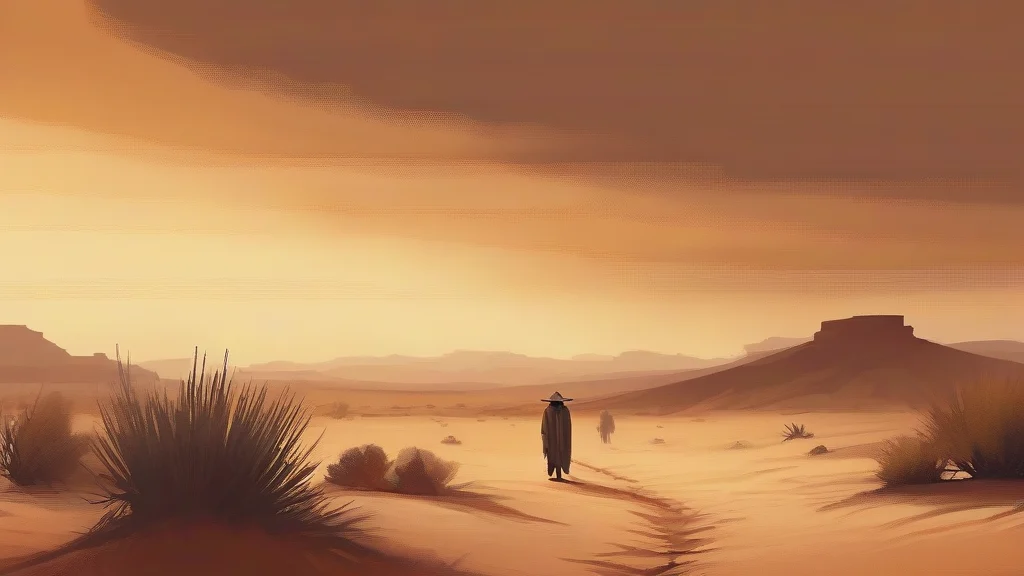
A large area of dry, barren land, typically covered with sand, that receives very little rainfall and supports minimal vegetation.
"Camels are well adapted to life in the desert."
Often capitalized when part of a proper name, as in the Gobi Desert.
(In the plural, 'deserts') That which a person deserves, whether reward or punishment, based on their actions or character.
"The villain finally got his just deserts."
Almost always used in the set phrase 'just deserts'; pronounced /dɪˈzɜːrts/, like 'desserts'.
To abandon someone or something, especially in breach of duty, loyalty, or obligation.
"Several soldiers were charged with attempting to desert their posts."
Stressed on the second syllable (/dɪˈzɜːrt/), unlike the noun.
The plural 'deserts' refers either to multiple arid regions or, idiomatically, to what one deserves ('just deserts').
"The world's great deserts include the Sahara, the Gobi, and the Kalahari."
'Desert' and 'dessert' come from completely different roots — and 'just deserts' with one s isn't a spelling mistake at all.
Reviewed by Deb Chak, Editor. AI-assisted content curated by RJS Tech Solutions LLP.
Etymology of desert
'Desert' entered Middle English from Old French 'desert', which derived from Late Latin 'desertum', meaning 'an abandoned or uninhabited place', from the Latin verb 'deserere' — 'to forsake or abandon'. The verb sense of abandoning came into English slightly later, from French 'déserter'. The same Latin root underlies related words such as 'deserve' (literally to serve well enough to merit something) and cognates like French 'désert' and Spanish 'desierto'. The spelling overlap with 'dessert' is coincidental: that word comes from French 'desservir', 'to clear the table'.
Related word forms
How desert is actually used
The noun meaning arid land is stressed on the first syllable (/ˈdɛzət/), while the verb 'to abandon' is stressed on the second (/dɪˈzɜːrt/). The phrase 'just deserts' is frequently misspelled 'just desserts'; the single-s form is correct because it comes from an old sense of 'deserve'.
Easily confused with desert
'Dessert' is the sweet course of a meal (spelled with two s's), while 'desert' as a noun means dry barren land or what one deserves.
'Deserts' can mean the plural of the arid-land 'desert', but in the phrase 'just deserts' it derives from the verb 'deserve' — it has nothing to do with sandy terrain.