
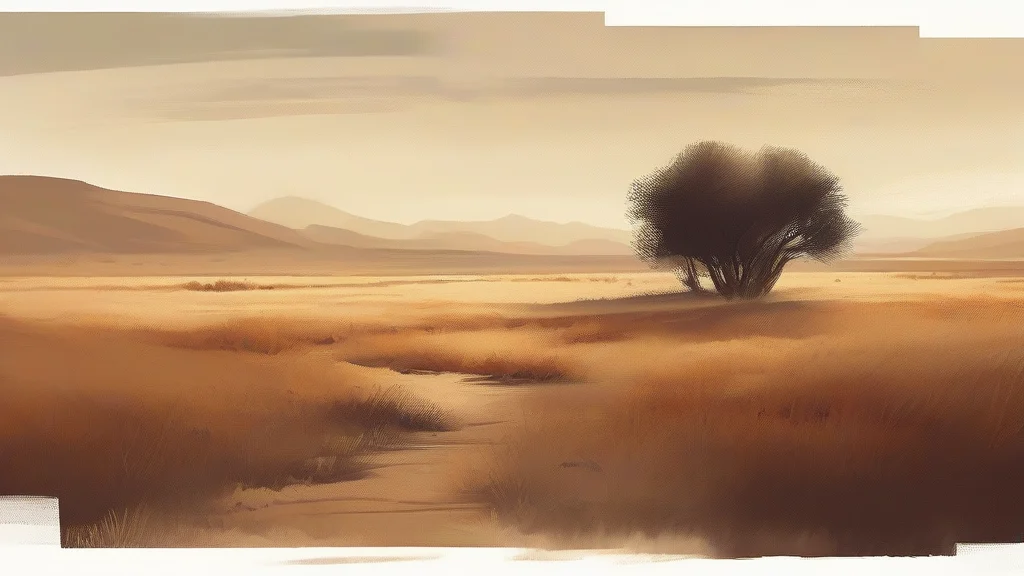
What does steppe mean?
A steppe is a wide, nearly level grassland with very few trees, found especially across the temperate interior of Eurasia, from eastern Europe through central Asia. Its soils can be fertile, but rainfall is generally limited, and conditions may become hot and dry during summer. For centuries, the steppe supported nomadic or semi-nomadic peoples who moved livestock between seasonal grazing areas, often traveling on horseback. The word is also used more broadly for comparable open grasslands elsewhere, but it carries a particularly strong association with the Eurasian grassland belt. In historical writing, the steppe appears in accounts of trade, migration, warfare, and cultural exchange across central Eurasia. Compared with the general word grassland, steppe suggests a vast, open, often treeless landscape with a distinct climate and historical character. It is therefore especially useful when discussing geography, ecology, or the cultural history of inland Eurasia.
nounA broad, usually level grassland with few trees, especially one in the temperate interior of Eurasia. The steppe is generally dry or semi-arid and is often associated with nomadic pastoralism.
- An extensive, mostly treeless grassland, especially in the temperate interior of Eurasia.
"The riders crossed the vast steppe as the evening sun lowered behind the distant hills."
"The wagon train crossed the steppe beneath a wide, cloudless sky."
"In historical accounts of Central Asia, the steppe is often portrayed as a homeland of nomadic horse riders."
The plural is used when referring to multiple distinct steppe regions or grasslands.
"The grasslands of central Asia include several distinct steppes."
Across the Eurasian steppe, mobile herding peoples developed cultures whose music, languages, and traditions still echo the journeys of their ancestors.
Reviewed by Deb Chak, Editor. AI-assisted content curated by RJS Tech Solutions LLP.
Where does steppe come from?
The English word entered use in the 17th century, borrowed through French from Russian степь (stepʹ), meaning an open plain or steppe. The Russian word is generally traced to a Turkic root associated with an open, uncultivated area. Its development reflects the long-standing linguistic contact between Russian and the Turkic-speaking peoples of the Eurasian steppe.
Related word forms
How steppe is actually used
The word is formal and primarily geographical or historical. It denotes a distinctive temperate grassland environment rather than grassland in general; in North America, prairie is the usual regional term.
Easily confused with steppe
A step is a single movement made by placing one foot in front of the other, whereas a steppe is a broad grassland or plain.