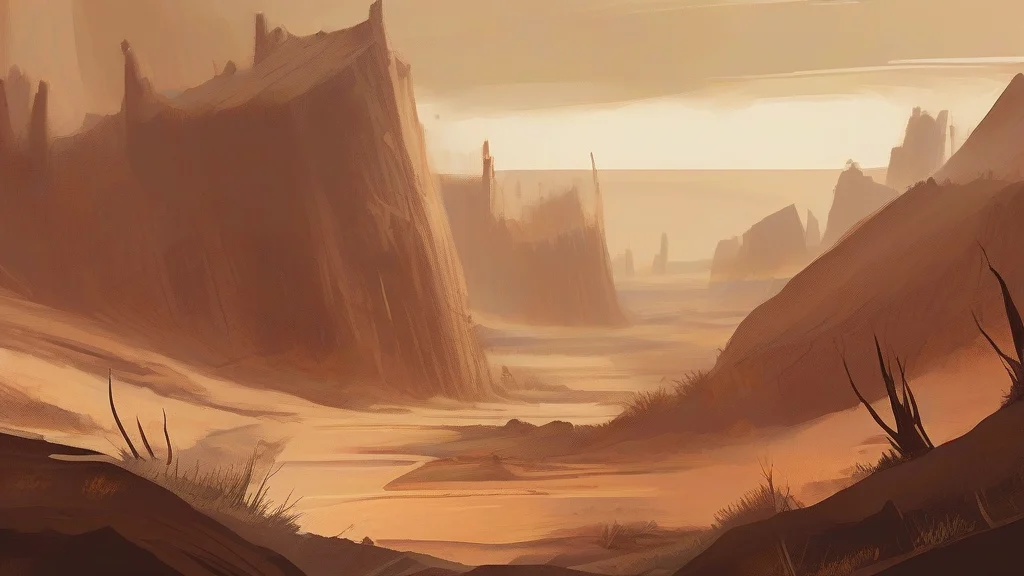
What does badland mean?
A badland is an area of strikingly eroded terrain, typically found in dry regions where soft sedimentary rocks such as clay, siltstone, and shale have been sculpted by intermittent heavy rainfall into a labyrinth of deep gullies, sharp ridges, and steep, unvegetated slopes. The word is nearly always used in its plural form, 'badlands', which can denote either any such landscape or, when capitalized, a specific named region — most famously Badlands National Park in South Dakota. The term originated with French fur trappers in North America, who described the difficult terrain as 'mauvaises terres' or 'bad lands to cross'. Today the word appears frequently in geography, geology, and travel writing, evoking both desolation and dramatic beauty. Badland country is prized by paleontologists, since erosion continually exposes fossils embedded in the rock layers.
nounAn area of rugged, heavily eroded terrain marked by deep gullies, steep slopes, and scant vegetation, typically formed in soft sedimentary rock. Usually encountered in the plural form 'badlands', the term refers collectively to such barren, difficult-to-traverse landscapes.
- A tract of rugged, intensely eroded terrain with little vegetation, characteristic of arid regions with soft sedimentary rock.
"The expedition crossed miles of sun-baked badland before reaching the river valley."
"Erosion over millions of years carved the soft shale into a maze of ridges and gullies, creating classic badland scenery."
"Fossil hunters flock to the badland formations because exposed rock layers reveal dinosaur bones with remarkable ease."
The plural 'badlands' is the standard and dominant form; it often functions as a mass noun describing such terrain generally, or as a proper noun when capitalized for named regions like Badlands National Park.
"The Badlands stretch across thousands of square kilometres of South Dakota."
The name comes from French trappers who called these eroded mazes 'les mauvaises terres à traverser' — literally 'the bad lands to cross'.
Reviewed by Deb Chak, Editor. AI-assisted content curated by RJS Tech Solutions LLP.
Etymology of badland
The word derives from English 'bad' combined with 'land', but its modern geographic usage traces to French-Canadian trappers of the northern Great Plains, who called such terrain 'les mauvaises terres à traverser' — 'the bad lands to cross' — because the broken ground was nearly impassable. English speakers adopted the translated phrase as 'badlands' in the 19th century, particularly in reference to the White River region of what is now South Dakota. The component 'land' descends from Proto-Germanic '*landą', making it a cousin of German 'Land' and Dutch 'land'.
Related word forms
How badland is actually used
The word is almost always used in its plural form, 'badlands'; the singular 'badland' is comparatively rare. The capitalized 'Badlands' commonly refers to specific named regions, most famously Badlands National Park in South Dakota. The term carries connotations of harshness, barrenness, and dramatic natural beauty.
Easily confused with badland
'Badlands' is the standard plural and by far the more common form used for such terrain, while 'badland' is the rarer singular referring to a single area or instance of it.