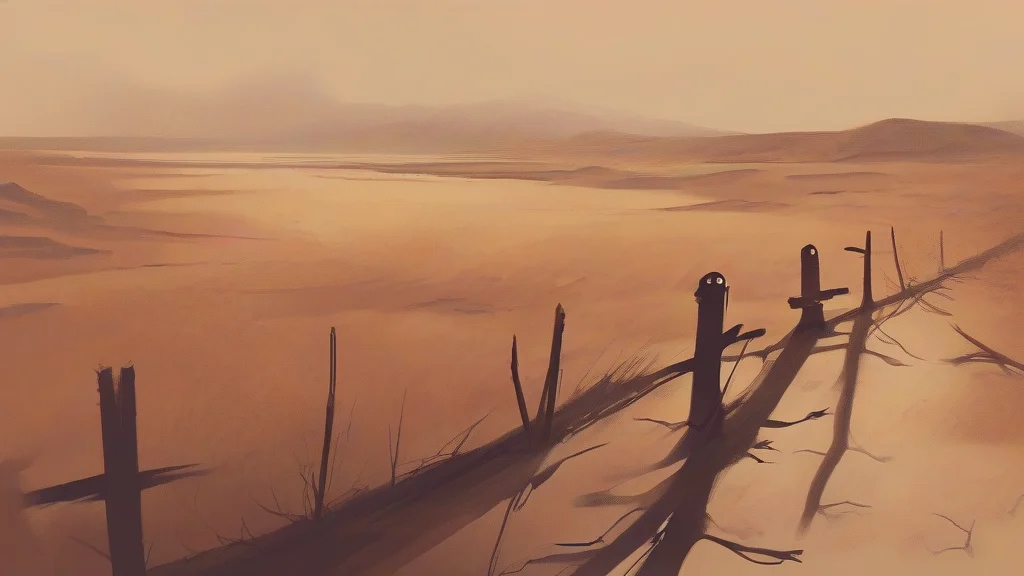
What does desolate mean?
Desolate is an evocative English word used chiefly as an adjective to describe places that are bleak, empty, and seemingly abandoned — think windswept moors, ruined villages, or barren stretches of coastline stripped of life and comfort. By extension it can describe people who feel wretched, forsaken, or overwhelmed by grief, conveying not just sadness but a sense of being utterly alone. Less commonly, desolate works as a verb meaning to lay waste to a place or to plunge someone into deep sorrow. The word derives from Latin desolare, built on solus, meaning alone, which makes it a close cousin of words like solitary and solitude — a fitting ancestry for a word whose core idea is emptiness and isolation. Writers prize desolate for the atmosphere it creates: a single desolate landscape can set a mood of abandonment, ruin, or quiet despair more economically than a paragraph of explanation. Its tone is literary rather than casual, making it especially useful in fiction, travel writing, and poetry.
Bleak, empty, and appearing abandoned or unfit for habitation; or, of a person, deeply wretched and bereft.
"The shipwrecked sailors faced weeks on a desolate island with little fresh water."
To make a place barren, ruined, or deprived of inhabitants; or, in literary use, to cause someone profound grief.
"Years of drought had desolated the farmland, leaving nothing but cracked earth."
Desolate literally means 'left all alone' — it descends from the same Latin root as 'solo' and 'solitary', so every desolate wasteland is etymologically a place where everyone has gone solo.
Reviewed by Deb Chak, Editor. AI-assisted content curated by RJS Tech Solutions LLP.
Etymology of desolate
Desolate comes from the Latin verb desolare, formed from de- ('thoroughly') plus solare, itself derived from solus, meaning 'alone'. The word entered Middle English via Old French desoler around the late medieval period, initially carrying strong religious overtones of spiritual devastation before broadening to describe both ruined places and grief-stricken people. Its Latin roots make it cognate with solitary, solitude, and sole, all tracing back to the same notion of aloneness.
Related word forms
How desolate is actually used
Desolate is a formal-to-neutral register word common in literary and descriptive writing about landscapes and emotional states. When applied to people, it carries a strong connotation of grief or abandonment rather than mere sadness, so it suits contexts of serious loss. The adjectival form is stressed on the first syllable (DES-o-lit), while the verb shifts stress to the final syllable (DES-o-late), a pattern worth preserving in speech.
Easily confused with desolate
Disconsolate describes only deep sadness or dejection in a person, while desolate applies chiefly to bleak, empty places and secondarily to people left grief-stricken or abandoned.
Dissolute means lax in morals or given to indulgent behavior, whereas desolate refers to barrenness of place or misery of spirit.