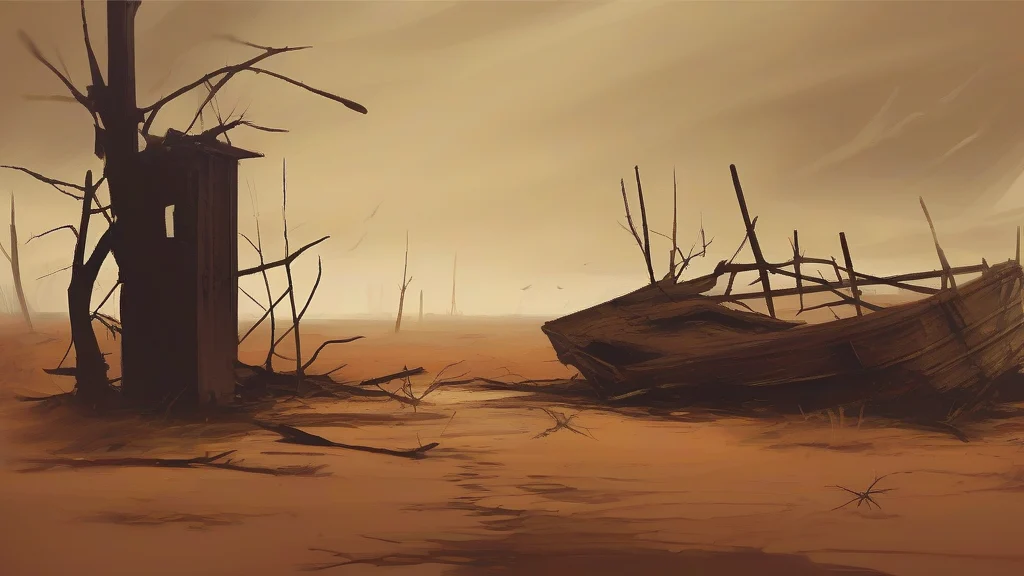
What does desolation mean?
Desolation is a noun describing two closely related states: the utter ruin or emptiness of a place, and the profound grief or loneliness felt by a person. A landscape ravaged by war, fire, or famine can be said to lie in desolation, while a person overwhelmed by loss may feel a crushing sense of desolation. The word is formal and literary in tone, lending gravity to descriptions of abandoned towns, barren wastelands, or hearts hollowed by sorrow. It derives from Latin dēsōlāre, meaning 'to abandon' or 'to leave alone,' combining de- (indicating removal) with solus (alone). This origin explains why desolation always suggests more than mere emptiness — it implies something once inhabited, flourishing, or loved that has been stripped away. Writers reach for it when they want a single word to convey devastation, whether of cities or spirits, making it one of English's most evocative terms for total loss.
nounA state of complete emptiness or destruction, especially of a place left ruined and uninhabitable; also a feeling of profound misery, grief, or loneliness.
- A state of complete devastation or ruin of a place — emptiness, barrenness, or destruction left by catastrophe or abandonment.
- A feeling of deep grief, misery, or wretched loneliness.
"The war left the once-prosperous city in utter desolation, its streets silent and its buildings reduced to rubble."
"After the flood receded, an air of desolation hung over the drowned village."
"She felt a wave of desolation when she realized no one was coming to meet her at the station."
Rarely used in the plural; appears mainly in literary or archaic contexts to refer to individual instances or scenes of ruin.
"The chronicle records the desolations wrought by successive invasions across the countryside."
"Desolation" hides "solace" inside it — the same Latin root for comfort — as if even the word itself carries the ghost of the comfort it has lost.
Reviewed by Deb Chak, Editor. AI-assisted content curated by RJS Tech Solutions LLP.
Etymology of desolation
Desolation comes from Latin dēsōlātiō, derived from the verb dēsōlāre, 'to abandon, leave alone,' formed from de- ('away from') and sōlus ('alone'). The word entered Middle English in the late medieval period through Old French desolation. Its Latin roots make it a cousin of solace and console, which share the same base relating to being alone or finding comfort.
How desolation is actually used
Formal to literary in register; rarely used in casual conversation. The word carries strong connotations of both physical ruin and emotional anguish, so writers often choose it deliberately for dramatic or poetic effect. It is typically uncountable, though 'desolations' appears occasionally in older or literary texts to refer to instances or scenes of ruin.
Easily confused with desolation
Destruction refers to the act of damaging something, while desolation describes the resulting state of ruin and emptiness, or the emotional despair that mirrors it.
Solitude is the state of being alone, often by choice and sometimes welcome, whereas desolation implies bleakness, abandonment, and misery.