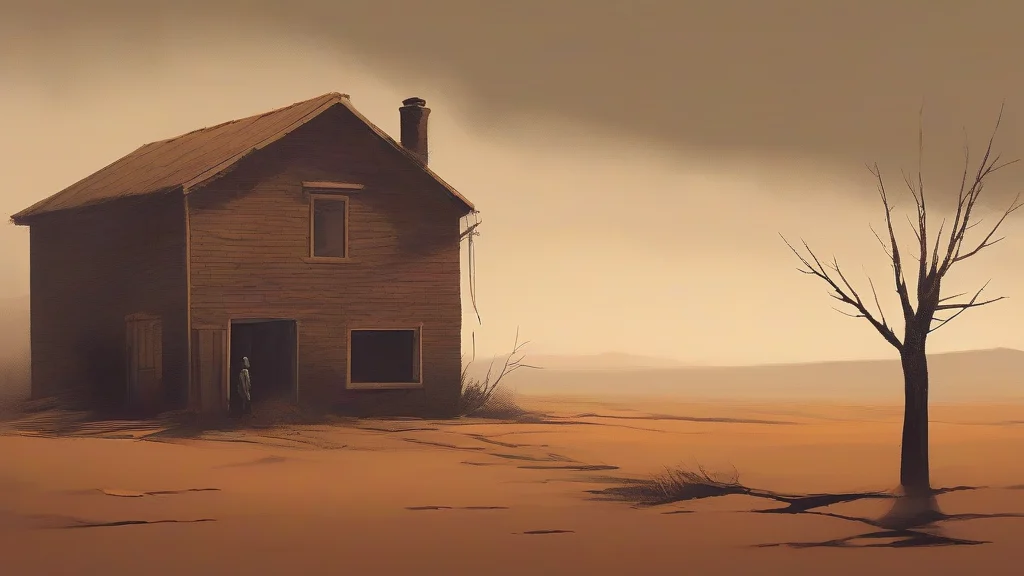
What does desolateness mean?
"Desolateness" is a formal, literary noun describing the state or quality of being desolate — that is, empty, abandoned, or bleakly uninhabited when applied to places, and profoundly lonely or wretched when applied to human feelings. A traveler might speak of the desolateness of an arctic island or a ruined city, while a novelist might use it to convey the inner desolateness of someone grieving or utterly alone. The word derives from "desolate," which traces back through Latin desolare, "to abandon," rooted in solus, "alone" — making aloneness central to its meaning. It is considerably rarer than its close synonym "desolation," which most writers choose instead, though "desolateness" can feel slightly more abstract, naming a quality rather than an act or event of laying waste. Because of its somber, evocative force, it appears mostly in elevated prose, poetry, and descriptive writing rather than casual speech.
nounThe state or quality of being desolate; a condition of bleak emptiness, barrenness, or profound loneliness and misery.
- The state of being deserted or uninhabited; bleak, barren emptiness of a place.
- The state of feeling wretched, lonely, or grief-stricken.
"The desolateness of the abandoned mining town was almost unbearable to witness."
"A strange desolateness hung over the windswept moor, where no house had stood for a century."
"After her closest friends moved away, she felt a quiet desolateness settle over her daily life."
Rarely pluralized, as abstract states of this kind normally appear only in the singular.
"The novel catalogues the desolatenesses of war-torn villages with unsparing detail."
"Desolateness" is the lonelier twin of the far more common "desolation" — so rare that many dictionaries barely record it, yet its root traces back to the Latin solus, meaning "alone."
Reviewed by Deb Chak, Editor. AI-assisted content curated by RJS Tech Solutions LLP.
Etymology of desolateness
"Desolateness" is formed from the adjective "desolate" plus the noun-forming suffix "-ness," a native Old English ending used to create abstract nouns of state or quality. "Desolate" itself comes from the Latin de-solare, "to leave alone, abandon," built on solus, "alone," the same root that gives us "solitary," "solace," and "sole." The compound likely arose in early modern English alongside other -ness formations, as writers sought an abstract term for the quality of desolation.
Related word forms
How desolateness is actually used
Formal and literary in register; in everyday English, "desolation" or simpler words like "loneliness" are strongly preferred. The word carries a heavy, somber connotation.
Easily confused with desolateness
"Desolation" is the far more common noun for the same idea of utter ruin or wretchedness, while "desolateness" is a rarer, more abstract variant emphasizing the quality or state of being desolate.