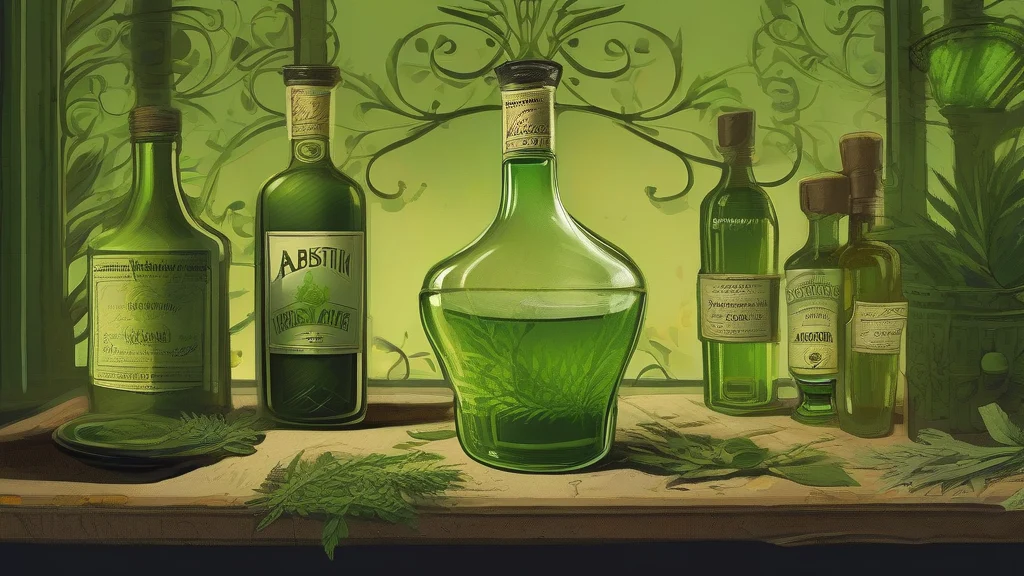
What does absinthe mean?
Absinthe is a noun naming both a famously potent green spirit and the wormwood plant from which it takes its flavour. Distilled with anise, fennel, and Artemisia absinthium, the drink turns cloudy pale green when diluted with cold water — a ritual known as 'louching' that became part of its mystique. Emerging in Switzerland in the late eighteenth century, absinthe rose to iconic status in nineteenth-century France, where it was embraced by artists and writers such as Verlaine, Van Gogh, and Hemingway, earning the nickname 'the Green Fairy.' Its reputation for causing hallucinations led to bans across Europe and America in the early twentieth century, though modern research showed these effects were exaggerated. Legal again since the 1990s–2000s, absinthe today denotes a distinctive, bitter-anise spirit with rich cultural associations, and the word also serves botanists describing the wormwood herb itself.
A strong, typically green, anise-flavoured spirit distilled with wormwood (Artemisia absinthium), traditionally diluted with ice water before drinking.
"In Belle Époque Paris, artists gathered at cafés for an afternoon glass of absinthe."
Used uncountably for the spirit in general and countably for individual servings ('a round of absinthes').
The wormwood plant (Artemisia absinthium), a bitter aromatic herb of the daisy family used to flavour the spirit and in traditional herbal medicine.
"Dried absinthe hung from the rafters of the old apothecary shop."
The plural applies only to individual servings or varieties of the drink; the spirit in general is treated as uncountable.
"The bartender poured two absinthes and set out the perforated spoons."
Banned across much of Europe and America for nearly a century, absinthe was blamed for hallucinations it never actually caused — the 'green fairy' was cleared by science long before it returned to bars.
Reviewed by Deb Chak, Editor. AI-assisted content curated by RJS Tech Solutions LLP.
Etymology of absinthe
The word absinthe comes from French, adopted into English in the early nineteenth century alongside the drink itself. It derives from Latin absinthium, meaning wormwood, which in turn traces back to Greek apsinthion, the classical name for the bitter herb. The same Latin root gives us the botanical name Artemisia absinthium, while 'wormwood' is the native Germanic word for the same plant rather than a true cognate.
Related word forms
How absinthe is actually used
Absinthe is a countable noun when referring to servings of the drink ('two absinthes') and uncountable when referring to the spirit generally. It carries strong literary and bohemian connotations thanks to its association with fin-de-siècle Parisian culture. The drink is very high in alcohol (typically 45–74% ABV) and is traditionally prepared by dilution rather than drunk neat.
Easily confused with absinthe
Anisette is a sweet, low-alcohol anise liqueur, whereas absinthe is a much stronger, unsweetened spirit traditionally made with wormwood.