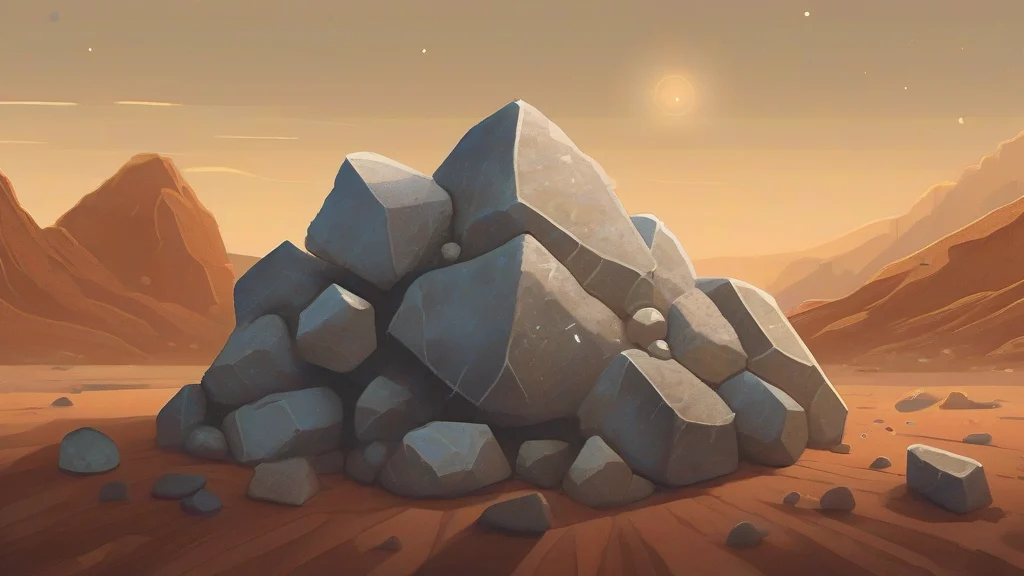
What does achondrite mean?
An achondrite is a stony meteorite distinguished by what it lacks: the tiny, round silicate beads called chondrules that fill most stone meteorites. Instead of this primitive, grainy texture, an achondrite has the appearance of terrestrial igneous rock — basalt-like, crystalline, and often strikingly earthlike under a microscope. That resemblance is no accident. Achondrites are fragments of planetesimals or planets large enough to have melted internally, separating into crust, mantle, and core; the material we recover on Earth is typically their volcanic surface rock. Some achondrites are among the most scientifically precious objects ever collected, having been identified as chips of the Moon or Mars, blasted into space by impacts before landing here. The term is chiefly used by meteoriticists, geologists, and serious collectors, and it stands as the counterpart to 'chondrite' within the stony-meteorite family. For anyone interested in where planets come from, achondrites are the direct evidence that other worlds once had molten interiors.
nounA stony meteorite that lacks the small rounded silicate grains (chondrules) characteristic of most stony meteorites, typically resembling terrestrial igneous rock in texture.
- A stony meteorite lacking chondrules, formed from differentiated planetary material such as lava flows or impact melt, including meteorites originating from the Moon, Mars, or asteroid Vesta.
"The meteorite recovered from the Antarctic ice proved to be an achondrite, its igneous texture setting it apart from the common chondritic stones."
"Scientists classified the fragment found in the Sahara as an achondrite because it contained no chondrules whatsoever."
"Because achondrites come from parent bodies that melted and separated into layers, they offer clues about the interiors of planets."
Standard English plural; used both for multiple physical specimens and for the class of meteorites as a group.
"Lunar achondrites command high prices among collectors because so few are ever recovered."
Some achondrites are pieces of the Moon or Mars — rocks you can hold that were blasted off another world by an ancient impact.
Reviewed by Deb Chak, Editor. AI-assisted content curated by RJS Tech Solutions LLP.
Etymology of achondrite
The word 'achondrite' derives from Greek roots: 'a-' meaning 'without' and 'chondros' meaning 'grain' or, in anatomical usage, 'cartilage'. It was formed in the nineteenth century by meteorite scientists as the negative counterpart of 'chondrite', which itself refers to the chondrules those meteorites contain. The same Greek root 'chondros' also gives us medical terms such as 'achondroplasia' and 'chondrocyte', though these belong to anatomy rather than astronomy.
How achondrite is actually used
Achondrite is a technical term used almost exclusively in planetary science, meteoritics, and collector circles; it is rare in general conversation. The word is always countable — individual specimens are referred to as achondrites. Subcategories include lunar, Martian (SNC), and howardite–eucrite–diogenite (HED) achondrites.
Easily confused with achondrite
A chondrite is a stony meteorite containing chondrules (small round grains), whereas an achondrite is defined by the absence of chondrules.
Achondroplasia is a genetic disorder of bone growth in humans and animals, while an achondrite is a type of meteorite; the words share only the Greek root for cartilage.