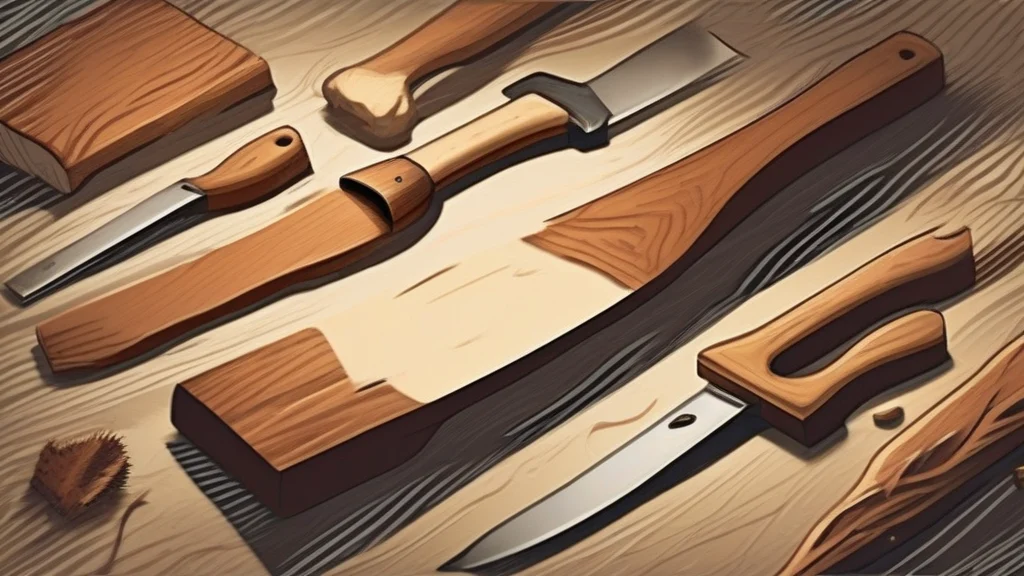
What does adze mean?
An adze is a hand tool used in woodworking, consisting of a thin arched blade mounted at a right angle to a wooden or metal handle. Unlike an axe, whose blade runs parallel to the haft for chopping and splitting, the adze's perpendicular edge allows the user to shave, smooth, and hollow out wood with controlled strokes. This makes it indispensable for tasks such as shaping curved timbers, dressing rough-hewn beams, scooping out troughs and bowls, and forming the planks of wooden boats. Carpenters, coopers, and shipwrights have relied on adzes for centuries, and they remain in use among traditional craftspeople today. Archaeologists also distinguish stone adzes from earlier hand axes when studying prehistoric cultures. Though largely replaced by powered machinery in industrial settings, the word retains a strong association with skilled manual craftsmanship. The spelling "adz" is a widely accepted variant of "adze."
nounA cutting tool similar to an axe but with the blade set at a right angle to the handle, used for shaping and dressing wood. It is chiefly associated with woodworking trades such as boatbuilding, coopering, and timber framing.
- A woodworking cutting tool with an arched blade set at right angles to the handle, used for dressing, shaping, and hollowing timber.
- (Figurative, rare) A person or thing that shapes or trims something roughly, as in literary metaphor.
"The shipwright smoothed the curved hull planks with a broad adze."
"He squared the rough beam with an adze before fitting it into the frame."
"In the museum's tool room, visitors can see the adzes that early carpenters used to hollow out dugout canoes."
The standard plural adds -es to the base form; it applies equally whether the singular is spelled "adze" or "adz."
"The workshop displayed a row of antique adzes on the wall."
Before power tools existed, entire wooden ships were shaped by hand with nothing more than an adze — its angled blade could scoop out hull planks that no ordinary axe could touch.
Reviewed by Deb Chak, Editor. AI-assisted content curated by RJS Tech Solutions LLP.
Etymology of adze
The word "adze" derives from Old English "adesa," meaning a cutting tool, which is related to similar forms in other Germanic languages such as Middle Low German "adesse" and Old High German "adas." Its ultimate deeper origin is uncertain, though it is generally treated as a native Germanic term rather than a borrowing from Latin or Greek. The modern spelling with a final "e" became standard in English after the Middle English period, while the shortened form "adz" emerged as a common variant, especially in North America.
Related word forms
How adze is actually used
The word is somewhat technical and appears most often in contexts relating to traditional woodworking, shipbuilding, archaeology, or historical craft. The spelling "adz" is a common variant, particularly in American usage. The plural is "adzes" (or "adzes"/"adzes" under either spelling).
Easily confused with adze
An axe has its blade aligned parallel with the handle for splitting or felling, whereas an adze has its blade set perpendicular to the handle for shaping and hollowing wood.
"Adz" is simply a variant spelling of "adze"; both refer to the same tool.