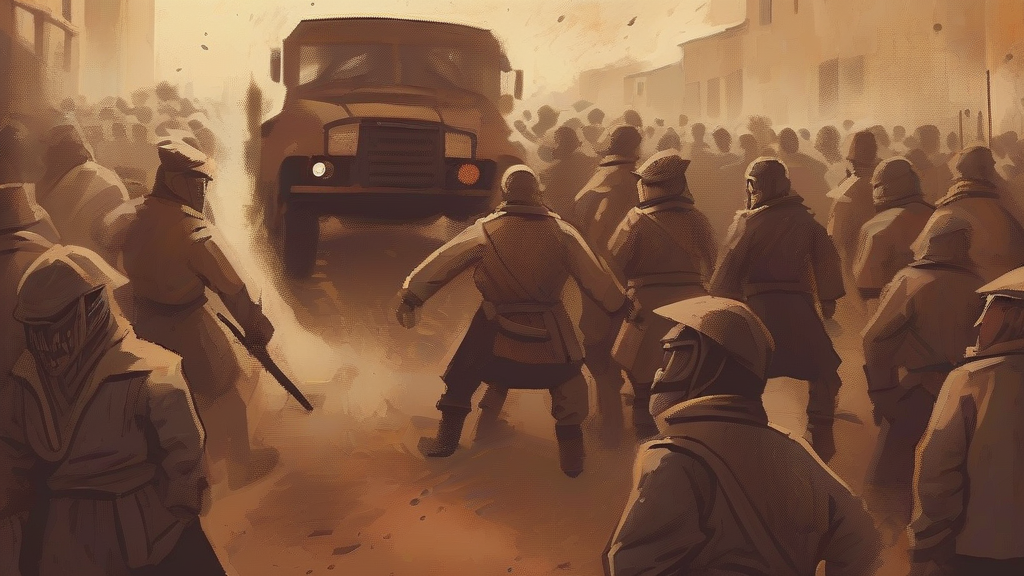
What does affray mean?
An affray is a public fight or violent disturbance, typically involving several people and taking place where others can see it. The word is most at home in legal and journalistic contexts, particularly in Britain, where it names a specific criminal offence: under the Public Order Act 1986, a person commits affray by using or threatening unlawful violence so that a bystander of reasonable firmness would fear for their safety. Notably, actual physical contact is not required — a credible threat made in public can suffice. Affray sits between lesser breaches of the peace and more serious offences like violent disorder on the scale of public-order crimes. Outside courtrooms and news reports it sounds somewhat formal or old-fashioned, evoking images of tavern brawls and street scuffles. Its synonyms include brawl, melee, and fracas, though none carry quite the same statutory weight. For readers of crime reporting or legal texts, recognising affray is essential to understanding how British law categorises public violence.
nounA public disturbance involving fighting or violence in a public place; in law, a criminal offence of engaging in a fight or violent disorder that causes others to fear for their safety.
- A public fight or violent disturbance involving several people.
- In law (especially UK), a specific public-order offence committed by using or threatening unlawful violence towards another such that a person of reasonable firmness present would fear for their safety.
"The police were called to break up an affray outside the pub late on Saturday night."
"Rival fans clashed in an affray that spilled out of the stadium and into the surrounding streets."
"He was charged with affray after brandishing a bottle during the confrontation, even though no one was struck."
The plural is straightforward but rarely needed, as the word usually refers to a single incident.
"The magistrate had seen countless affrays pass through his courtroom over the years."
In English law, merely threatening violence in a way that frightens bystanders can count as affray — you don't even need to land a punch.
Reviewed by Deb Chak, Editor. AI-assisted content curated by RJS Tech Solutions LLP.
Etymology of affray
Affray entered English from Anglo-Norman French in the medieval period, deriving from the Old French verb 'effreer' (to frighten), which itself comes from the Vulgar Latin 'exfridare', built on the Germanic root '*frithuz' meaning peace. The original sense was thus tied to causing alarm or terror, and the word long carried the meaning of disturbing the peace. It shares this Germanic-Latin lineage with words like 'afraid' and 'affright', which retain the fear sense while affray came to denote the disturbance itself.
How affray is actually used
Affray is chiefly used in British English and carries a distinctly legal register; it is rare in everyday American speech, where 'brawl' or 'melee' are preferred. In UK law under the Public Order Act 1986, affray is more serious than a 'breach of the peace' but less serious than 'violent disorder', and it can be committed by threat alone. The word connotes disorderly, semi-public violence rather than private quarrels.
Easily confused with affray
Afraid means feeling fear, while affray is a noun denoting a public fight or violent disturbance — they share a French root but have entirely different meanings.
A brawl is a general term for a noisy fight, whereas affray specifically carries legal weight as a formal public-order offence in British law.