
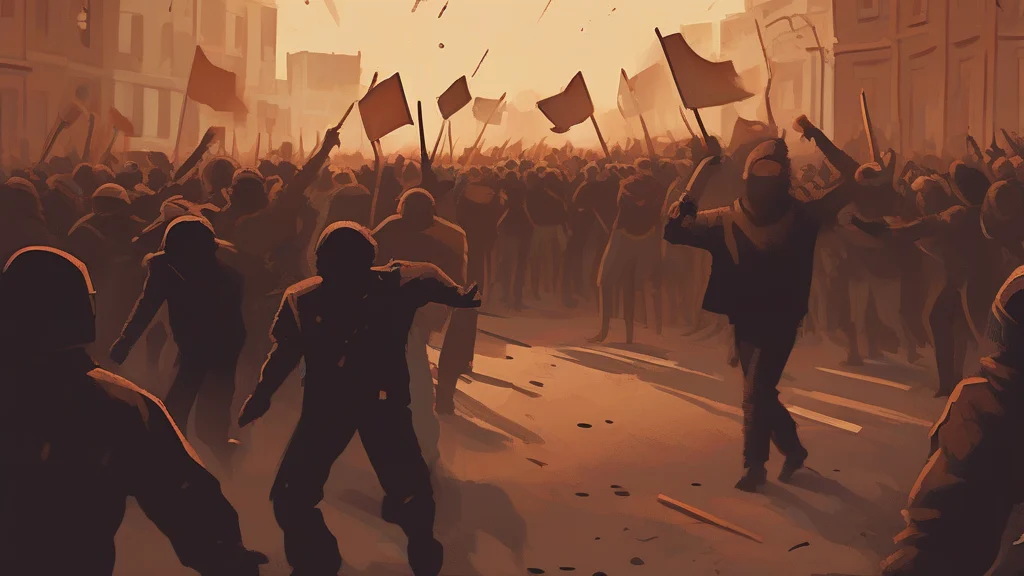
What does riot mean?
A riot is a violent public disturbance in which a crowd breaks the law, destroys property, or clashes with authorities. The word can also describe a wild and uninhibited display of celebration, emotion, or activity: a concert may be described as a riot of sound, while a street may erupt in a riot of color. As a verb, riot means to participate in a public disturbance or to behave in an uncontrolled, disorderly fashion. Although riot often carries a serious and sometimes legal meaning, its figurative uses can be playful, emphasizing exuberance rather than violence. The term is used in both British and American English and appears in established expressions such as riot control, riot police, and run riot. It is important to distinguish a riot from a revolt: a revolt is generally an organized political rebellion, while a riot is characterized by disorder and public violence.
A violent disturbance of public order, especially one involving a crowd acting unlawfully.
"Police used containment procedures to control the riot."
This is the dominant modern sense and is commonly used in legal, journalistic, and historical contexts.
A wild, exuberant, or uncontrolled display of activity, emotion, or celebration.
"The performance was a riot of rhythm and color."
This figurative sense is informal to neutral and emphasizes energetic excess rather than violence.
To engage in a riot or behave in a violent and disorderly manner.
"Several people rioted after the verdict was announced."
This sense is factual and typically reports unlawful collective disorder.
To behave in a wildly exuberant or unrestrained way.
"The dancers rioted across the stage during the finale."
This figurative use is informal and often describes celebration or uninhibited activity.
The usual plural, as in 'the riots of 2020'; in the figurative sense, 'a riot of color' is normally uncountable when describing an event or display.
"Several riots broke out in the city overnight."
A riot is more than a noisy crowd: it is a breakdown of public order in which collective energy becomes destructive.
Reviewed by Deb Chak, Editor. AI-assisted content curated by RJS Tech Solutions LLP.
Etymology of riot
The word entered Middle English from Old French riot, meaning revolt, disturbance, or commotion, which was derived from medieval Latin riotum, associated with turbulence and disorder. Its development reflects the older sense of confusion or tumult before the modern emphasis on violent public disorder. The English derivatives riotous and rioter developed from the same lexical root.
Related word forms
How riot is actually used
In its primary sense, riot is a formal term for a serious public disturbance and is generally used in news reporting, legal contexts, and historical discussion. In the figurative sense, it often suggests uninhibited excitement, celebration, or uncontrolled behavior, as in 'a riot of color.' The verb is often transitive when it means to disrupt or overrun, as in 'rioted the streets,' but this usage is less common in formal writing.
Easily confused with riot
A revolt is an uprising or rebellion against authority, whereas a riot is primarily a violent public disturbance that may or may not have a political aim.