
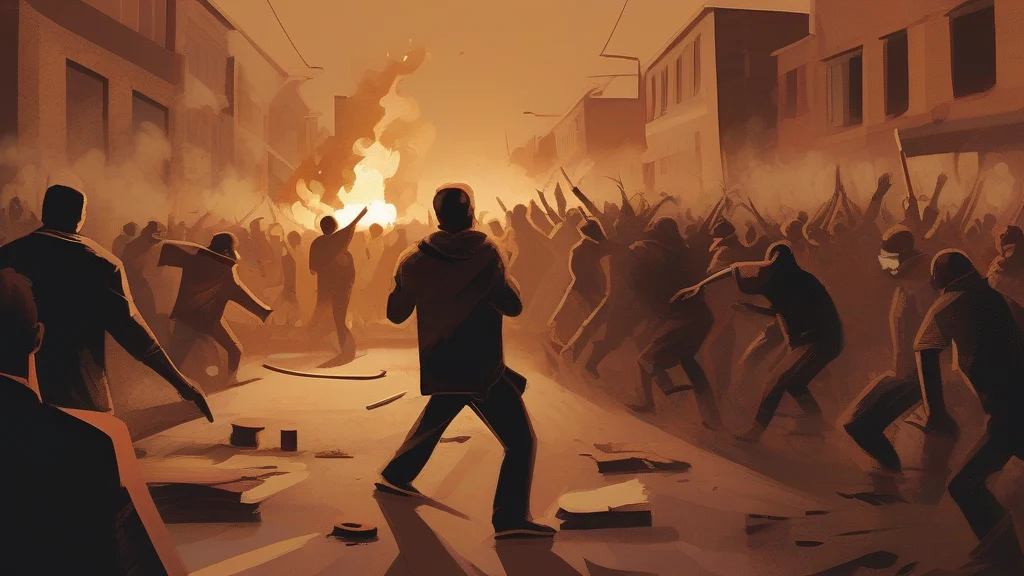
What does rioting mean?
Rioting denotes violent or disorderly behavior by a group, especially a crowd protesting political, social, or economic conditions. It can function as an uncountable noun naming the activity or as the present participle of “riot,” describing people engaged in it. The word generally carries a strongly negative and legal connotation: unlike the broader term “protesting,” rioting suggests conduct that has become violent or seriously disruptive. In news reporting, it commonly appears with expressions such as “street rioting,” while legal language may refer to people being “convicted of rioting.” Because the term distinguishes disorderly or violent behavior from peaceful demonstration, it should be applied carefully and only where those features are present. Its history belongs to the older English vocabulary of public commotion and collective revolt.
The activity of rioting; violent or disorderly behavior by a group, especially during public protest.
"The city imposed restrictions after rioting disrupted several streets."
Usually uncountable. It describes collective behavior and is often used in news, legal, and political contexts.
Present participle of “riot,” meaning to take part in violent or disorderly public behavior.
"Several people were charged with rioting after the confrontation."
This is an inflected verb form rather than a separate lexical verb.
Rare and generally unnecessary; the activity is normally treated as uncountable.
"The historical record includes isolated reports of riotings in several towns."
Rioting entered English through the history of political rebellion and public disorder, a legal and social issue long before it became a modern media description.
Reviewed by Deb Chak, Editor. AI-assisted content curated by RJS Tech Solutions LLP.
Etymology of rioting
The modern family derives from Middle English “riote,” meaning public disorder, tumult, or rebellion, borrowed from Old French “riote.” Old French “riote” came through a verb meaning to quarrel or raise tumult, ultimately associated with Latin “riotari,” a rare term connected with rivalry, contention, or tumult. The sense developed from generalized disorder toward the modern idea of a violent public disturbance. Related English forms include “riot,” “rioter,” and the adjective “riotous.”
Related word forms
How rioting is actually used
The term is strongly negative and normally refers to collective public disorder or violence. It is frequently used in legal, news, and political reporting; in non-journalistic contexts, “protesting” may be neutral or positive, while “rioting” specifically suggests violence or serious disorder.
Easily confused with rioting
No distinction applies because these are variant forms of the same word.