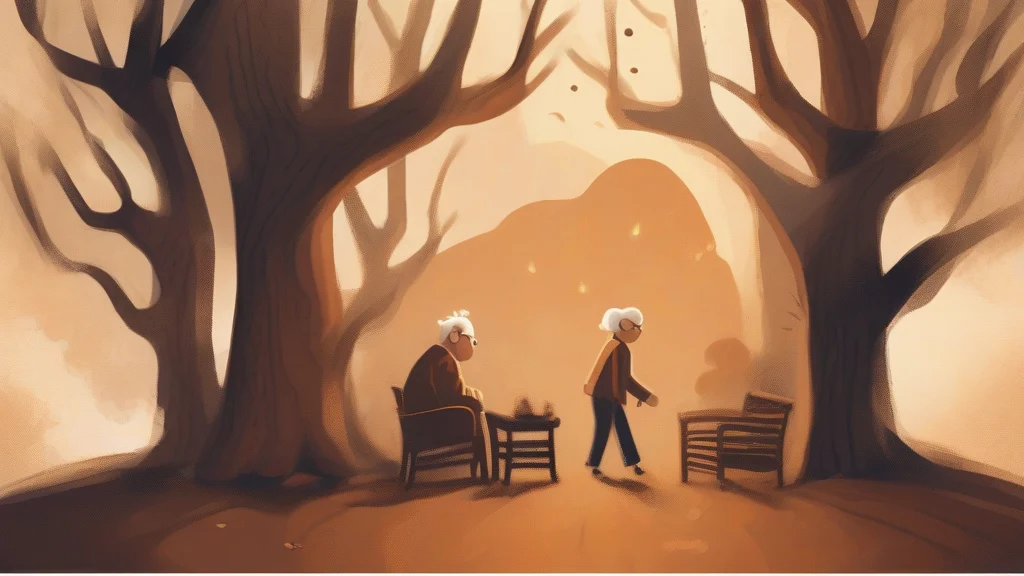
What does aging mean?
Aging refers to the process of growing old or maturing over time, whether applied to people, animals, plants, materials, or even ideas. In biology and medicine, it describes the gradual accumulation of changes in a living organism that unfold across its lifespan, often associated with declining function but also with development and experience. Beyond living things, aging applies to objects and substances: wood weathers, buildings deteriorate, and foods such as cheese, wine, and whiskey may improve through deliberate aging. The word carries different connotations depending on context — it can suggest decline and loss when discussing human health, or quality and refinement when discussing fine products. It functions as a noun ('the aging process'), a verb form (the present participle of 'to age'), and an adjective ('an aging rock star'). Spelled 'ageing' in British English and 'aging' in American English, it remains one of the most universally discussed phenomena in science, culture, and everyday life.
The process of growing old or showing the effects of increasing age.
"Scientists study aging to understand why cells deteriorate over time."
Often used in scientific, medical, and demographic contexts.
Present participle of 'age'; to grow old or cause something to become older or more mature.
"The wine is aging gracefully in oak barrels."
Commonly used in progressive constructions and as a gerund.
Becoming old; showing signs of advancing age.
"An aging bridge was finally scheduled for repair."
Typically used attributively before a noun.
Rarely used; 'aging' is almost always treated as an uncountable noun referring to a process rather than a countable entity.
"Different cell types exhibit distinct agings under experimental conditions."
Every second, your body replaces millions of cells — yet aging is still the one process no scientist has fully learned to stop.
Reviewed by Deb Chak, Editor. AI-assisted content curated by RJS Tech Solutions LLP.
Etymology of aging
The word 'aging' derives from 'age', which came into Middle English from Old French 'aage' (modern French âge), ultimately rooted in Vulgar Latin *aetaticum, from Latin 'aetas' meaning 'period of life' or 'age'. This Latin term itself traces back to 'aevum', meaning eternity or lifetime, a root shared with words like 'medieval', 'coeval', and 'primeval'. The spelling 'aging' reflects American convention, while British English retains the older 'ageing'. The verb 'to age' developed in English by the late Middle Ages, and its present participle form became widely used as both noun and adjective.
Related word forms
How aging is actually used
'Aging' is neutral to slightly negative when describing human decline, but positive in contexts like wine or cheese, where aging implies improvement. In British English, the spelling 'ageing' is standard; both spellings are pronounced identically.
Easily confused with aging
'Ageing' is simply the British English spelling of the same word, while 'aging' is the standard American spelling; they are pronounced identically and mean the same thing.